A dual-surface website still has an order
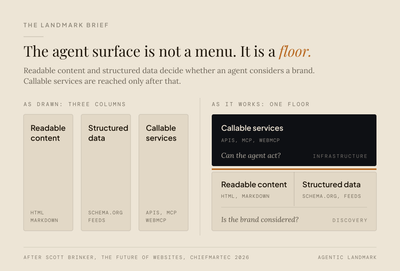
Scott Brinker’s dual-surface website is the right picture. But its agent half is a sequence, not a menu: discovery decides which brands an agent considers, and only then are a brand’s services called.
Agentic Landmark · The Brief
Briefs on the infrastructure, authorization architecture, and commerce strategy of the agentic web: what brands need so agents can find, evaluate, and transact with them.
Scott Brinker’s dual-surface website is the right picture. But its agent half is a sequence, not a menu: discovery decides which brands an agent considers, and only then are a brand’s services called.
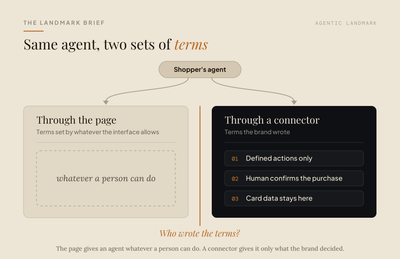
When an agent can use the page a human uses, the page is the only rule the brand wrote. Walmart has written its rules down. Most brands have not.
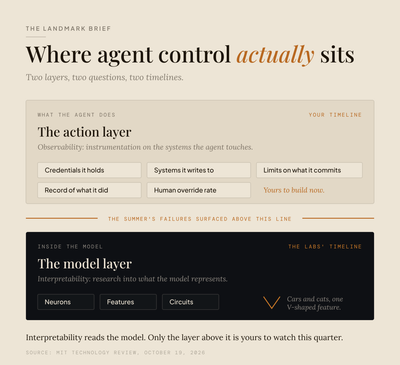
A viral claim says AI models may be readable after all. Even if it is right, the summer’s agent failures happened in the world, not in a neuron. Seeing what your agents do is instrumentation, and it is yours to build now.
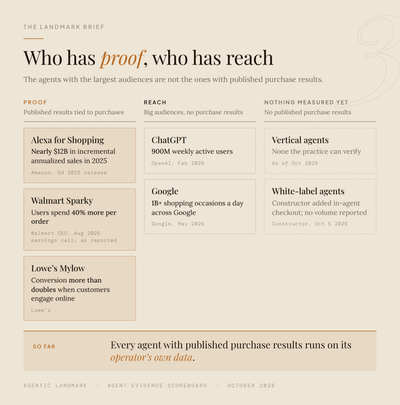
Sort shopping agents by evidence instead of audience and the order changes. Three have published purchase results, all run by retailers on their own data. Two have nothing measured yet.
Five kinds of shopping agent already evaluate your products, and each fails a brand for a different reason. A map of the five, what each needs from you, and the one requirement they all share.
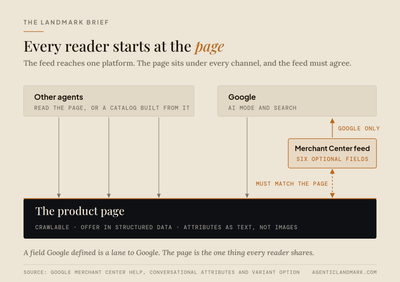
Google has published six optional Merchant Center fields that tell its conversational surfaces what to know about a product. What each one carries, which to fill first, and the rule that keeps the feed from replacing the page: the values have to match.
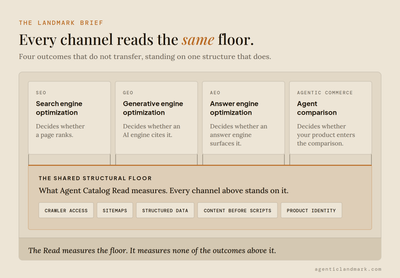
In a recorded test on fictional storefronts, an AI shopping agent passed over the highest-rated shoe in five of five runs. Its specs were in an image. This Brief covers the structural floor under every discovery channel, and the free instrument that reads it.
Amazon shut Meta's Muse agent out and Shopify let it in, twelve days after quietly switching the channel on for roughly a million merchants. Both platforms made the same decision on behalf of every brand underneath them. What the default turned on, and what to do this week.
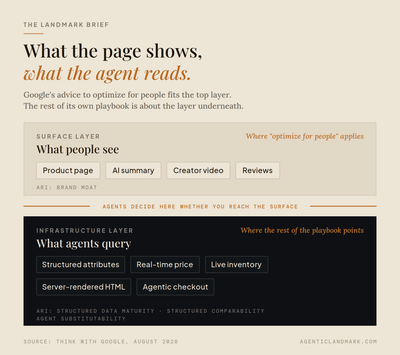
Google's holiday guidance tells retailers to optimize for people, not bots. Its other recommendations are all written for machines: richer product feeds, real-time price and inventory, agentic checkout. The contradiction resolves once you separate the surface layer from the infrastructure layer.
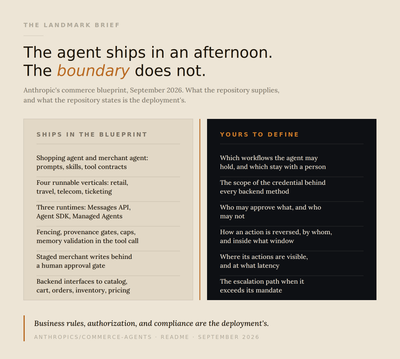
Fifteen minutes to a working commerce agent. The repository's own note hands authorization, business rules, and compliance back to the deployment, and that is the part that decides whether any of it should be running.