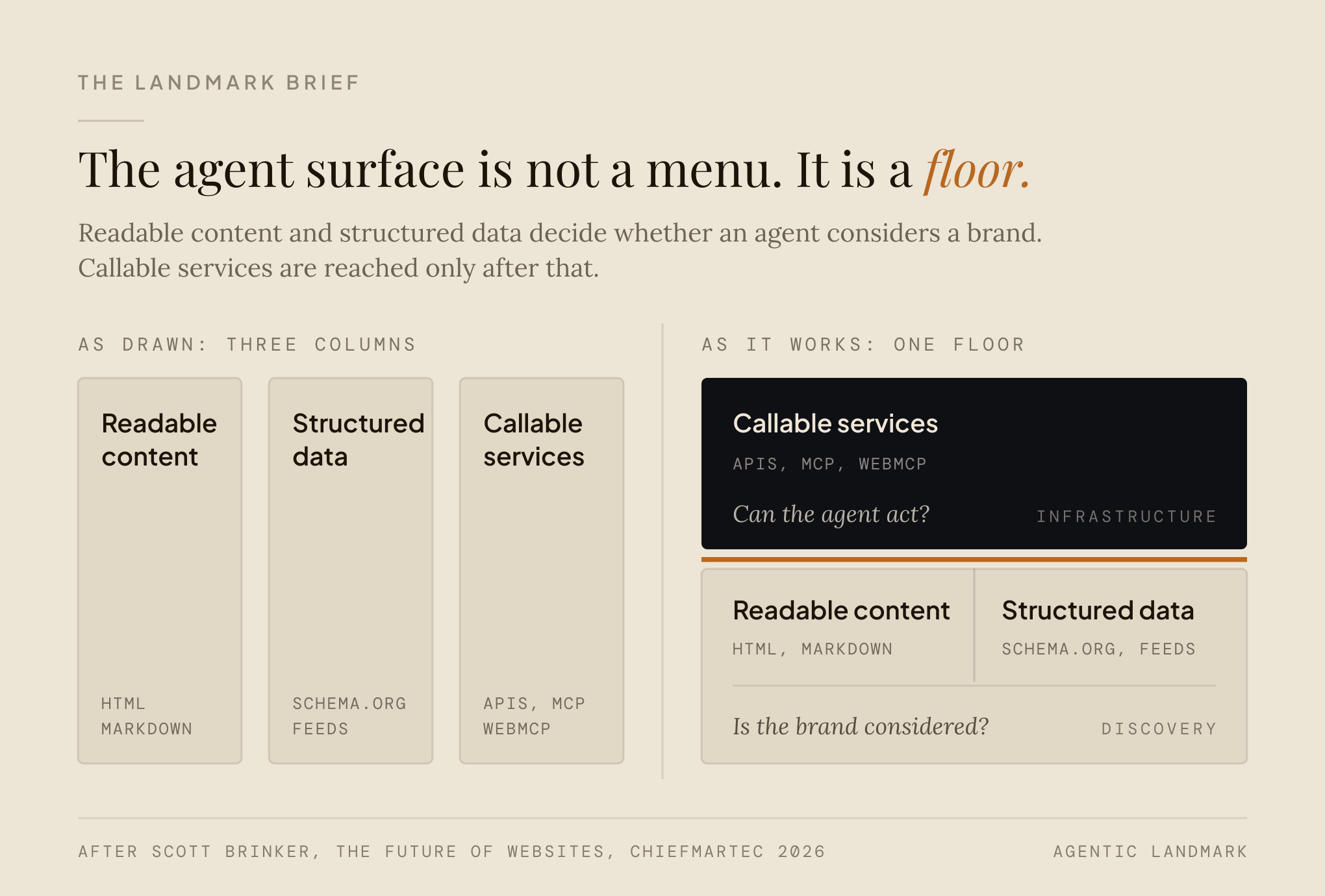
The agent half of the dual-surface website is drawn as a menu. It is a sequence.
The website splits into two
Scott Brinker's new chiefmartec report, The Future of Websites, published with Knotch, makes the clearest case yet that a brand's website now serves two audiences that want different things. Humans get what he calls an intent-responsive surface: an experience that adapts to what visitors say they want, inside bounds the brand sets. Agents get a semantic and service surface: content they can read, data they can parse, and services they can call.
Underneath both sits a brand context model. It is a layer above the CMS, DAM, PIM, and knowledge base that keeps every surface drawing on the same current version of the brand.
Most of the report is right, and the practice agrees with more of it than it argues with. But the agent half of the picture is drawn as three things to provide, side by side. It is a sequence. That difference decides where a brand's next dollar goes.
What the report gets right
Three ideas in it deserve to travel.
The first is brand latency. Brinker names the gap between what a brand intends customers to see and what they actually see, and traces it to page debt: the cost of keeping every page variant in sync with a business that keeps moving. For agents, brand latency is not cosmetic. An agent that reads a stale price or a retired policy repeats it with confidence, and the brand never sees the conversation where it happened.
The second is that the agent surface is real and distinct. He sets out readable content, structured data, and callable services, with the standards for each. Readable content is HTML, Markdown, and sitemaps. Structured data is Schema.org in JSON-LD and product feeds. Callable services run through APIs and a set of agent protocols: MCP lets an agent call a brand's tools, WebMCP exposes those tools from inside a web page, A2A lets agents coordinate with one another, and UCP is a commerce protocol for completing a purchase inside an agent. That is a fair map of what agents consume.
The third is the line that carries the report: "It's the composition that is generated, not the ground truth." The brand context model assembles experiences from exact inputs rather than inventing them. For agents, that is the right instinct. An agent cannot tell a generated claim from a governed one, so the brand has to make sure only one kind is on offer.
A menu that is really a sequence
The report presents readable content, structured data, and callable services as three things a high-fidelity agent experience provides. Read as a checklist, a brand could start anywhere. Many will start with services, because an MCP server is a visible, fundable project with a launch date.
That is backwards. An agent's job starts with an answer. Before it calls anything, it decides which brands are worth considering, and it decides from what it can find, read and compare. That is the discovery layer: crawler access, structured product and entity data, and attributes complete enough to put one product next to another.
Only a brand in the consideration set gets its services invoked. The infrastructure layer, where agents query live state and act, pays off only once discovery is already true. Readiness in one does not transfer to the other. A brand can be cited and still unusable, and a brand with excellent endpoints that no agent shortlists has built an execution layer nobody calls.
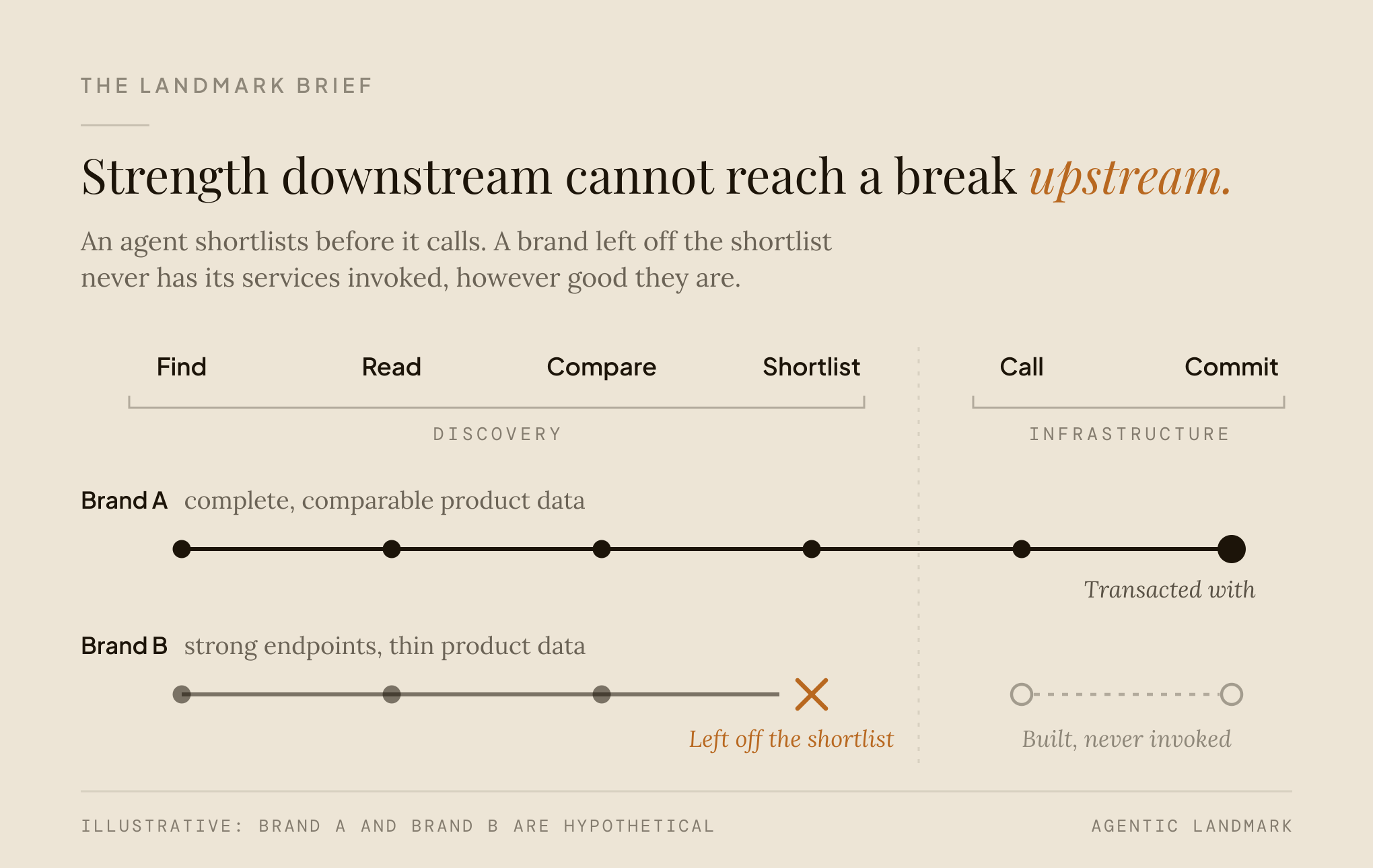
Strength downstream cannot make up for a break upstream, because downstream is never reached. Read Brinker's three columns that way and they stop being peers. Readable content and structured data are the floor. Callable services stand on it.
What the agent surface also has to carry
Three questions the report leaves open belong to the agent surface specifically.
- Who else is calling. The endpoints that admit a customer's agent also admit a competitor's. Price, assortment, and inventory exposed for consumer agents are open to pricing intelligence and catalog harvesting by default. Access design is a governance decision, not only a technical one.
- On whose authority. The report describes agents acting on a customer's behalf. It does not address how the brand knows an agent holds that authority, or what happens at the moment of commitment when it does not. For a purchase, a booking, or a service request, that check is the last gate before the brand is bound.
- What the brand can see. The report's analytics section is strong on humans: expressed intent captured as zero-party data and fed back to CRM and CDP. Agents get no equivalent. Most brands cannot yet separate agent visits from other automated traffic, or tie an agent visit to an outcome. A model that learns only from human visitors will optimize the surface it can observe.
None of these is solved by a better model of the brand. They are decisions about who gets in, on whose authority, and how the brand finds out.
Four questions, in order
For a CMO reading Brinker's report and deciding what to fund, four questions locate the brand faster than an architecture diagram.
- When an agent compares us with our two closest competitors, can it pull the attributes that decide the choice from our product pages, without running JavaScript? The major AI crawlers read the initial HTML and do not render scripts.
- Does our structured data match today's price, availability and policy, or does it lag the site the way our pages lag the business?
- If we exposed a service tomorrow, who could call it, and how would we know whether they were acting for a customer?
- Can we see agent visits in our numbers today, and tie any of them to revenue?
The first two are discovery. The last two are infrastructure and measurement. Answer them in that order. The Agent Catalog Read starts with the first.
A brand context model may be where many brands end up. The order they get there in is the part they control now. Readable, structured content gets a brand considered. Callable services get it transacted with. The second depends entirely on the first.