A dual-surface website still has an order
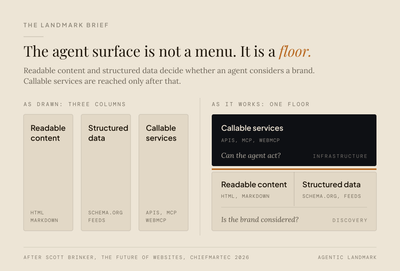
Scott Brinker’s dual-surface website is the right picture. But its agent half is a sequence, not a menu: discovery decides which brands an agent considers, and only then are a brand’s services called.
Agentic Landmark · The Brief
Briefs tagged geo in The Landmark Brief.
Scott Brinker’s dual-surface website is the right picture. But its agent half is a sequence, not a menu: discovery decides which brands an agent considers, and only then are a brand’s services called.
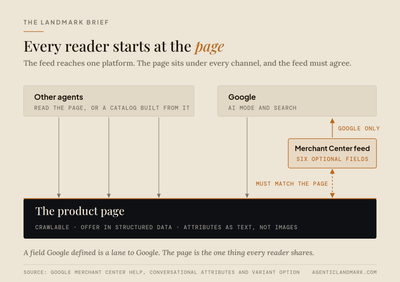
Google has published six optional Merchant Center fields that tell its conversational surfaces what to know about a product. What each one carries, which to fill first, and the rule that keeps the feed from replacing the page: the values have to match.
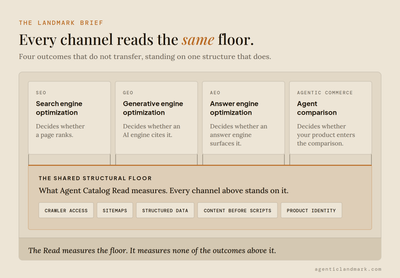
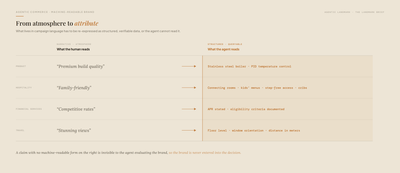
In a recorded test on fictional storefronts, an AI shopping agent passed over the highest-rated shoe in five of five runs. Its specs were in an image. This Brief covers the structural floor under every discovery channel, and the free instrument that reads it.
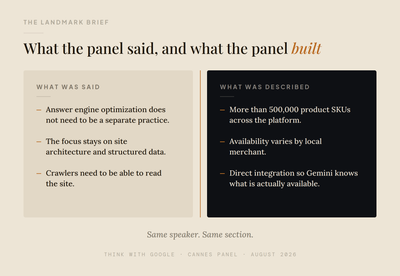
Think with Google told brands that foundational SEO remains the formula for AI search visibility. In the same article, DoorDash describes integrating 500,000 SKUs with merchant-level availability so Gemini knows what is actually in stock. The example refutes the headline.
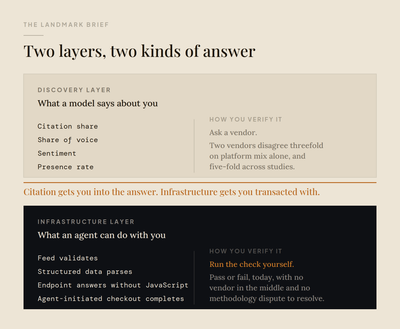
McKinsey published two figures for brand-owned share of LLM citations eight months apart. They differ five-fold, and the firm reconciles neither. The gap is not a scandal. It is what happens when an industry builds a capability around a number nobody can measure twice.
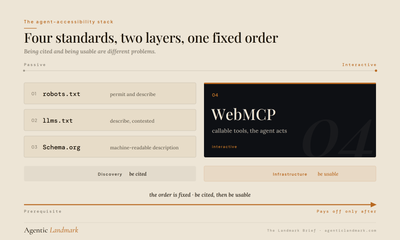
Most agent-ready advice collapses two different problems into one. Being cited and being usable run on different infrastructure, fail in different ways, and must be fixed in a fixed order. A map of the four-standard stack, from robots.txt to WebMCP, and why the sequence is the argument.
Every brand spent years learning to be memorable to humans. The next decade is about being legible to machines, not the same skill. A machine-readable brand is not good SEO or a chatbot. It is identity, claims, and offerings as structured data an agent can retrieve and reason from.
Contentful's Palmata makes one thing measurable: how answer engines represent your brand, past visibility into why and what to change. The measurement layer for AI discovery is now a category, not a feature. But it measures representation, not transactability, and that instrument does not exist yet.
Google says you do not need llms.txt for Search, and it just added a Lighthouse check for it. Both are true, because they answer to different audiences. It is not a search signal; it is an agent signal, the site's way of telling a browser agent where to start. Google is now measuring both.
Google's new guidance says you are overthinking AI search, no llms.txt, no AI-specific pages, no overfocus on structured data. For Google's own search features, that is right. For an agent querying your catalog through ACP or UCP, it is the opposite.