An agent recommends what it can verify, and that is not always the better product.
The better shoe lost
We built a small running-shoe category on fictional storefronts and let a live AI shopping agent buy from it. Four shoes. The one we cared about was the Meridian Arc: the highest rating in the set at 4.7, priced at $140, two dollars above its nearest rival, the Cadence GT at $138.
We ran the agent five times under each of two conditions. In the first, the shopper told the agent they liked Meridian. The agent bought the Arc in five of five runs. In the second, the shopper stated no brand preference. The agent recommended the Cadence GT in five of five runs and named the Arc as runner-up.
Nothing in the setup steered it. The prompts never mentioned specifications. The search returned every product page with no ranking applied. The agents reached the result on their own, and they explained it in their own words. The scene is on the Agent Readiness Index page, recorded from those runs.
The specs were in a picture
The Arc's stability class, its widths, its heel-to-toe drop and its shipping terms sat in an image. A runner looking at the page sees all of it at once: 275 grams, an 8mm drop, D and 2E widths. The agent saw a table it could not read, and said so.
It did read the Arc's prose. It quoted the fit notes and counted them in the Arc's favor. So the copy was never the problem. The problem was that every claim a shopper would need confirmed before buying was unverifiable, and the Cadence GT stated its equivalents as text.
We set the price so it could not be the explanation. At $140 against $138, the two shoes differ in one respect: whether their specifications can be read. The shopper with a brand preference got the Arc without the agent ever learning its drop. The shopper without one got the other shoe.
Three channels, one floor
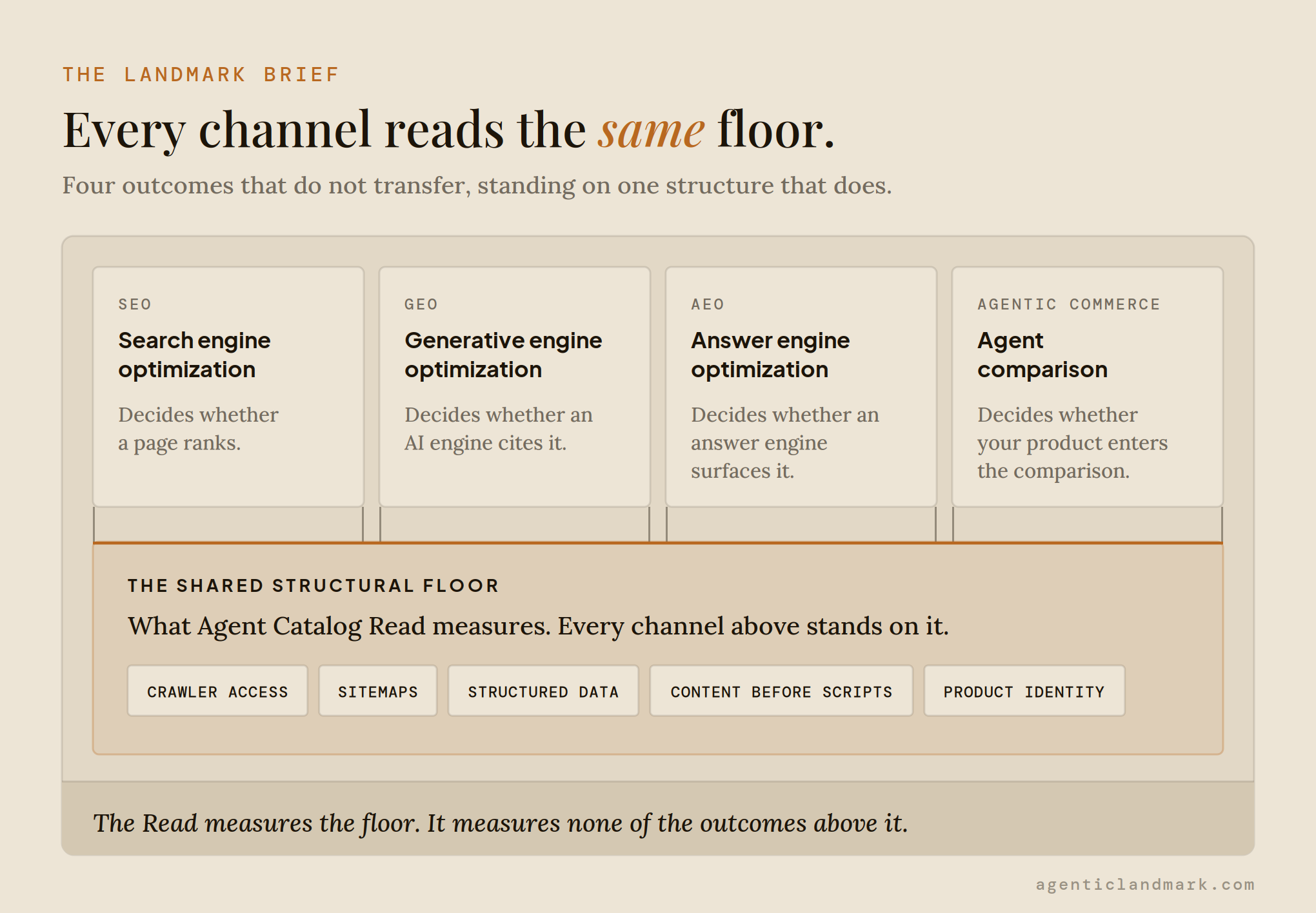
Most brands are now funding three programs for being found: SEO for rankings, GEO for citations in AI answers, and AEO for being surfaced by answer engines and agents. The outcomes do not transfer. Boston Consulting Group measured only an 8 to 12 percent overlap between traditional search results and AI-generated answers in March 2026. A ranking does not become a citation, and a citation does not become a recommendation.
What the three share is underneath them. One product page a machine can parse. One offer with its price and availability stated. One product identity held consistently across URL, schema and feed. Each channel reads that floor, whether or not anyone has measured it.
The floor is weaker than most teams assume. In Adobe's Q2 2026 AI traffic report, product detail pages scored 63.5 on AI citation readability even among the top fifth of companies by AI visits, second lowest of any commercial page type. And the major AI crawlers, including GPTBot, ClaudeBot and PerplexityBot, read the initial HTML without executing JavaScript, so anything a page renders in the browser is not in what they read.
The Arc is that gap made visible. Its page looked complete to every human who opened it.
Reading the floor, product by product
Agent Catalog Read is the instrument we built to measure that floor. What an agent can extract from your product pages, product by product. A structural read for agentic commerce.
The Read arrives the way an agent does. It takes a sample of a brand's public product pages, chosen by a fixed rule so a second Read of the same catalog reads the same pages. For each one it asks what is present in the page an agent receives, before any script runs.
Is the path to the product page open to AI crawlers? Is the offer stated in structured data, with a price and an availability, whether the site uses JSON-LD, microdata or RDFa? Are the attributes a shopper would compare stated as text, or trapped in an image or a PDF the way the Arc's were?
The answers come back per product, not averaged. An average hides exactly the case that matters: the hero product whose specs live in a graphic, sitting among a catalog that otherwise reads fine.
What the Read does not do
The Read produces no score. No band, no grade, no ranking against competitors. That is a design decision, not a gap.
A number invites optimizing the number. A finding that says the Arc's widths are in an image tells a merchandising team what to change on Monday. The Read reports what an agent could and could not extract, and stops there.
It also covers structure only. Whether an AI answer cites you, and how often against your competitors, is a different question with a different measurement. Structure comes first because it is upstream: a page an agent cannot parse gives citation work nothing to stand on.
It is not a short version of the Agent Readiness Index either. The Index scores a brand's exposure to agent-mediated buying across five dimensions. The Read examines one surface, the product page, closely enough to act on.
The shopper you were trying to win
Run A is the comfortable result. Brand preference carried the Arc past its unreadable page. But brand preference only protects you with customers you already have.
Run B is the shopper every acquisition budget is aimed at: no loyalty, a clear need, an agent doing the comparison. That shopper never saw the Arc's spec image. Their agent read the page, could not confirm what it needed, and recommended the other shoe. Nobody at Meridian would see that loss in their analytics. It looks like a visit that did not happen.
Three channels, three outcomes, one floor. The floor is the only part you can fix once.
Agent Catalog Read is free, and the method is published at agenticlandmark.com/agent-catalog-read.