A dual-surface website still has an order
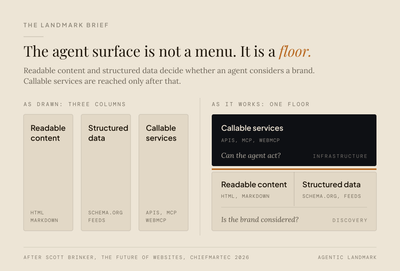
Scott Brinker’s dual-surface website is the right picture. But its agent half is a sequence, not a menu: discovery decides which brands an agent considers, and only then are a brand’s services called.
Agentic Landmark · The Brief
Briefs tagged ucp in The Landmark Brief.
Scott Brinker’s dual-surface website is the right picture. But its agent half is a sequence, not a menu: discovery decides which brands an agent considers, and only then are a brand’s services called.
Amazon shut Meta's Muse agent out and Shopify let it in, twelve days after quietly switching the channel on for roughly a million merchants. Both platforms made the same decision on behalf of every brand underneath them. What the default turned on, and what to do this week.
Adyen Agentic removes the protocol-fragmentation bet: integrate once, and it translates your catalog across every agentic platform. The thesis is right, build for the layer, not the platform. But the layer solves integration, not data quality. A bad catalog gets distributed everywhere at once.
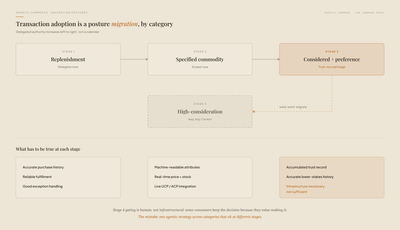
The agentic commerce conversation conflates two behaviors: using AI to discover and letting AI buy. Discovery is mainstream; delegated transaction is a fraction of it, because trust accrues on a schedule no announcement can rush. Adoption moves category by category, through four delegation postures.
Every agentic commerce protocol was built to reassure merchants: the brand stays the merchant of record. Real protection, and incomplete. The merchant of record is not the merchant of decision, and under agents the two unbundle. The decision is made on the platform before your checkout ever fires.
Forrester is right that agentic commerce calls for strategy over urgency, not panic. But "prepare now" implies the viable moment is ahead. For the brands on Google's Universal Cart launch list, it already arrived. The infrastructure timeline and the urgency timeline are the same timeline.
Every platform now offers retailers the agent intelligence it built for itself, on its own infrastructure. You keep the brand label; they keep the nervous system. The retailers who own the next decade will read that offer clearly and choose which layer to rent and which to own.
For thirty years the cart was something you filled, one store at a time. Google's Universal Cart inverts that: the agent assembles it across every merchant that can answer its questions. There is no browsing phase to abandon. The cart is built from a brief.
Google's I/O announcements are not previews, they are production. The Universal Cart, the AP2 authorization layer, and UCP expansion are shipping to a billion AI Mode users. The launch merchant list is the first public ranking of which brands are inside the infrastructure.
Google's three new UCP capabilities, cart, catalog, and identity linking, are not features but a diagnostic: each one names an infrastructure gap, catalog completeness, real-time queryability, and agent-ready loyalty, that decides whether your brand can use the protocol.