Anthropic collapsed weeks of agent scaffolding into an afternoon and left the authorization model exactly where it was.
What shipped
The repository went public on September 2. It holds a shopping agent a business embeds in its own app for customers, and a merchant agent its staff uses to run the back office. Four runnable verticals: retail, travel, telecom, and ticketing. A Claude Code plugin that scaffolds an agent against your systems. Apache-2.0, with Visa, Mastercard, and Accenture named as enablement partners and Shopify, Priceline, Intuit, Klaviyo, Wix, Square, Zomato, and Fetch quoted in the announcement.
The speed claims are the part worth reading closely. Wix reports engineers had a working commerce agent taking prompts within fifteen minutes. Fetch reports both agents running locally in well under an hour, and describes the result as turning days of agent scaffolding into hours. Those are vendor-supplied quotes in a launch post, so treat them as directional. But nothing in the repository contradicts them. The scaffolding problem is solved.
The sentence most readers will skip
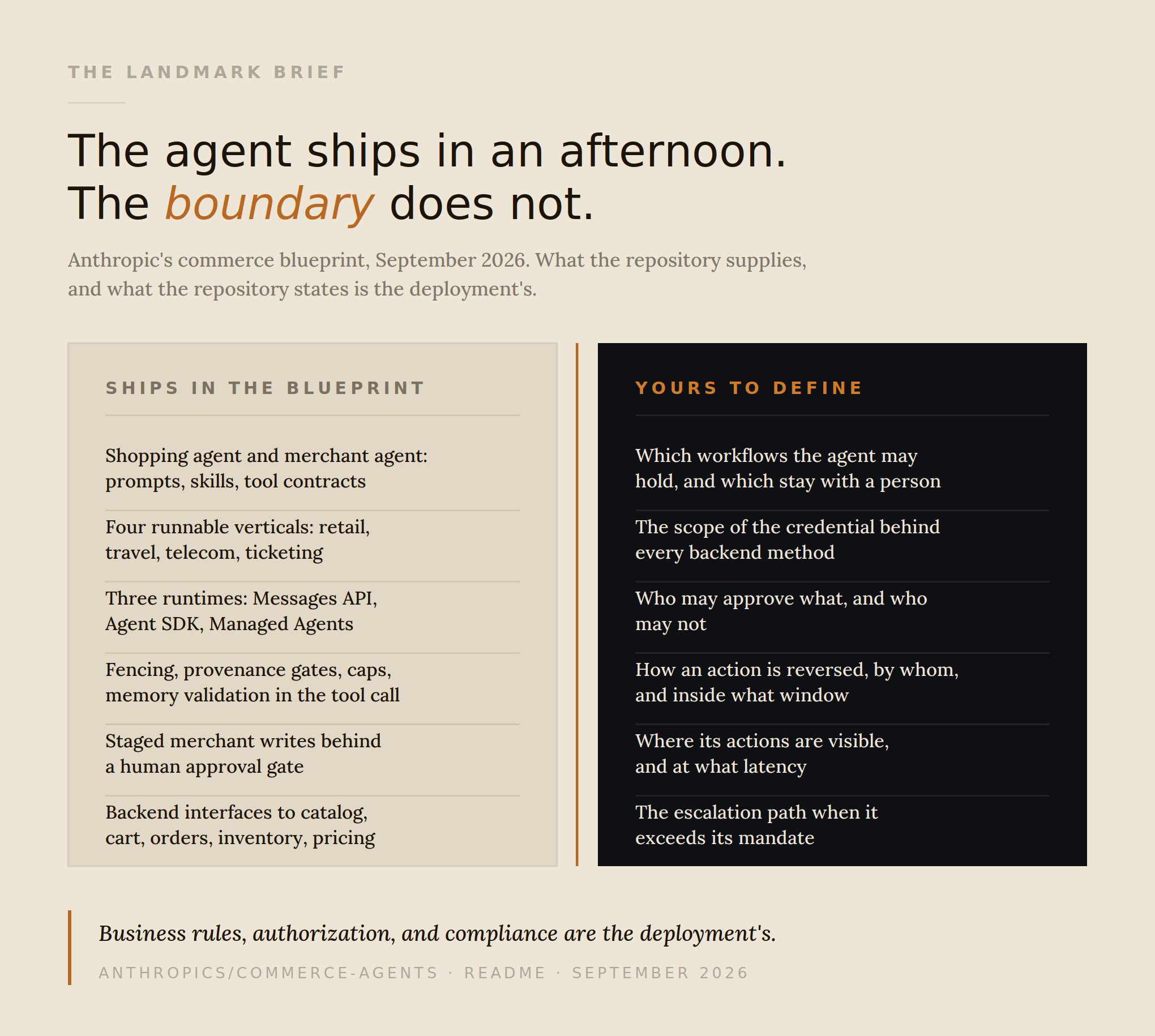
The note at the top of the repository, above the quick start, says that business rules, authorization, and compliance are the deployment's.
That is the correct scope decision. It is also the most consequential line in the launch, and it will be read past by almost everyone who forks the repo, because it appears as a disclaimer and reads like boilerplate. It is neither. It is a precise statement of where the blueprint stops, and the thing it stops short of is the thing that determines whether an operational agent is safe to run.
The blast radius is the service account, not the agent
The blueprint's integration model is sound. Each backend method calls your service server-side with the credential your host holds for the session, and the model reads only the result. The agent never touches a credential. The checkout URL is returned by the backend and rendered by the host, and the model never sees it either.
Follow that design one step further. If the model reads only results, then the agent's reach is exactly the reach of the credential sitting behind those backend methods. The blueprint does not scope that credential. It cannot. It does not know your systems.
In practice, that credential is provisioned once, during integration week, by whoever was unblocking the build. It is scoped generously because narrow scoping breaks the demo. It is never revisited, because nothing in the delivery process asks anyone to revisit it. A merchant agent that recommends pricing changes, adjusts inventory, edits listings, and drafts campaigns inherits every permission that account holds, including the ones nobody remembered granting.
The repository gives you an honest place to start. A merchant pilot can implement the eight read methods and have the writes refuse, and digests and metrics then run with no write path at all. A read-only deployment carries no operational exposure and should not be scored as though it does. The exposure begins the hour the writes turn on. It does not begin at the agent. It begins at a permission grant made weeks earlier by someone who was not making a risk decision.
An approval gate is a control, not a boundary
Every merchant write in the blueprint is staged until a person approves it, and the approval gate runs inside the tool call rather than in the surrounding application, so it holds across all three runtimes. That is better than what most in-house deployments will build, and it deserves credit.
It is still a checkpoint rather than a model. An approval gate answers one question: did a human say yes? It does not answer who is entitled to say yes to what. It does not say what a yes covers when forty staged changes arrive in one digest and the approver has four minutes. It does not prevent the person who asked for the change from being the person who approves it. It does not produce a record that lets anyone reconstruct, six weeks later, why a price moved and on whose authority.
The repository is equally direct about its own posture elsewhere: the examples ship with no authentication, and the MCP servers bind to loopback. Correct for a reference implementation. It also means the first real deployment decision is one the reference has deliberately declined to make for you.
What actually got scarce
When standing up an agent cost a team six weeks, the binding constraint was engineering. Every organization understood that constraint, budgeted for it, and staffed against it. The blueprint removes it.
The constraint that remains is the one no organization has an artifact for. Which workflows should this agent hold, and which should stay with a person? What authority does it carry inside each one? How is an action reversed once taken, and by whom, and inside what window? Who can see what it did, in what system, at what latency? What happens on the escalation path when it encounters something outside its mandate?
Those five questions are the operational readiness problem, and none of them is an engineering question. They are authorization design, reversibility, observability, workflow suitability, and governance. Anthropic shipped the harness and said so plainly. The hard part was never the harness.
The order the work goes in
The temptation, once a working agent exists in fifteen minutes, is to treat the boundary as a hardening pass scheduled after the pilot proves value. That ordering fails for a specific reason. The pilot proves value by turning writes on. The moment writes are on, the credential scope, the approval model, and the audit record are already in production, established by default rather than by decision, and every subsequent change to them is a migration instead of a design.
Define the boundary before the fork, not after the demo. Name the workflows the agent may hold. Scope the service account to those workflows and nothing adjacent. Decide what a reversal looks like before you need one. Write down who approves what, and make sure it is not the same person who requested it. None of this takes six weeks. It takes a week, and it is the only week that does not get cheaper as the models improve.
The fifteen minutes are real. They produce a working agent. Whether it is a deployable one depends on work the blueprint correctly declined to do, and that work still takes months when it is discovered late.