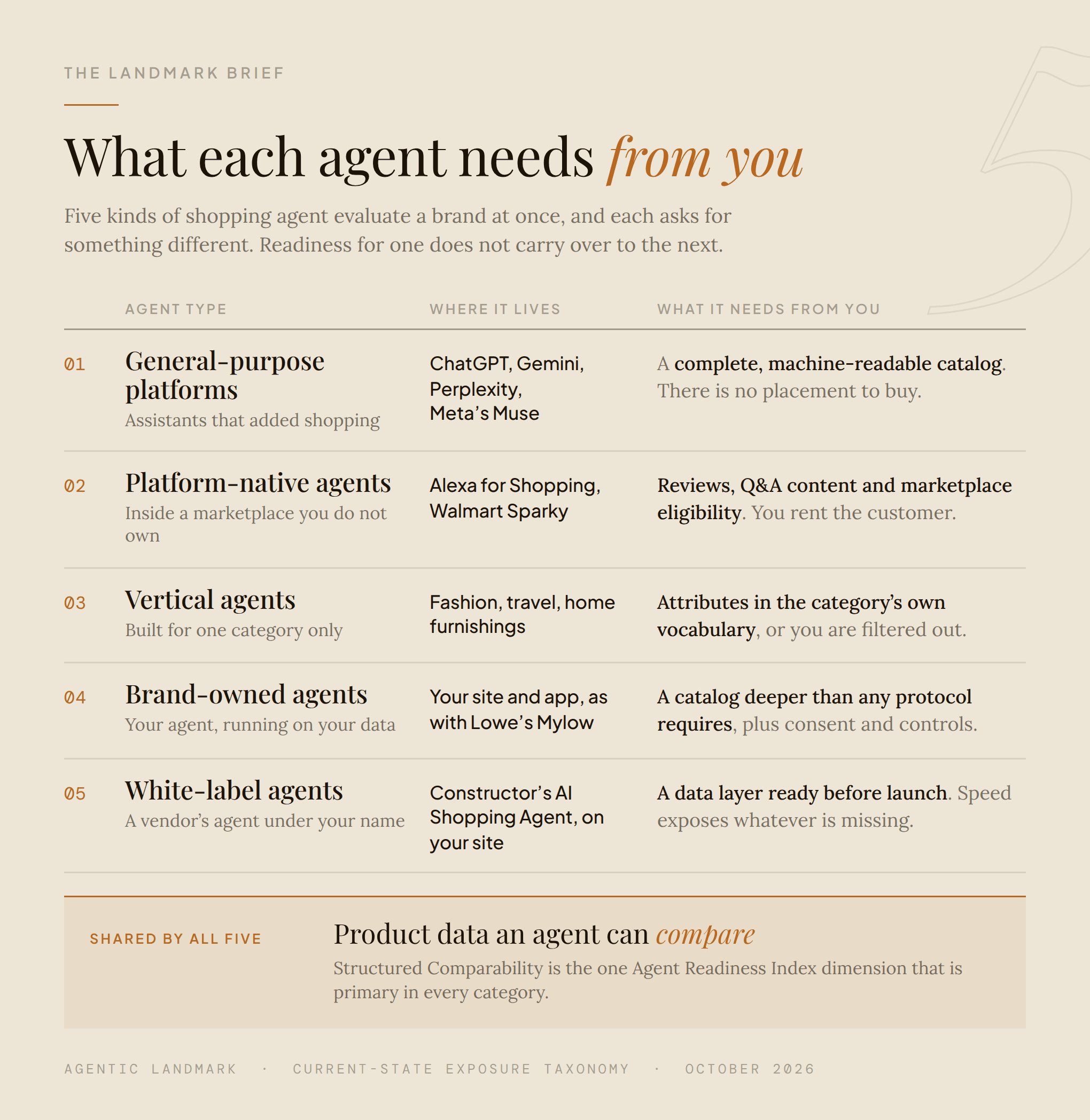
Most brands now accept that agents will decide a share of how their products are found and bought. Fewer have asked which agents. The work under way in most organizations, a cleaner product feed, a structured data review, perhaps a protocol integration, quietly assumes one kind of agent with one set of requirements.
There are five. They are built differently, and they choose products by different logic, so a brand ready for one can be absent from the other four. A complete protocol integration does nothing for a brand's position inside Amazon's assistant. A strong Amazon catalog tells a fashion-only agent nothing about how a dress drapes. Neither answers the question a CMO eventually asks: should we build our own?
What follows is the map the practice draws before any readiness work is scoped. It describes which agents are evaluating a brand today. It is not a forecast of which one wins.
General-purpose platforms: the data is the whole relationship
ChatGPT, Gemini, Perplexity, Copilot and Claude were not built for shopping. They added commerce because their users kept asking them to buy things. Reach is why this category comes first: OpenAI confirmed 900 million weekly active users in February 2026.
The list is still growing. Meta's Muse joined it in September 2026, when Shopify began sharing its merchants' catalogs with Meta by default. No brand made that call, which is the argument of Neither platform asked the brand.
What these platforms do not offer is a relationship. There is no account manager, and on Perplexity there is no paid placement at all: it ranks products on intent match, schema completeness, price freshness and review trust. A brand's presence is decided by whether its product data is complete, accurate and readable by a machine, and by very little else.
The checkout picture has moved. OpenAI scaled back in-chat Instant Checkout in early 2026, and the model that has held across platforms is discover in the agent, buy on the brand's own site. The protocols persist. ACP, the Agentic Commerce Protocol from OpenAI and Stripe, and UCP, the Universal Commerce Protocol from Google and Shopify, both define how an agent reads a catalog and reaches checkout. But the commercial event here is the agent's evaluation and shortlist, and that happens whether or not the cart sits inside the chat.
The readiness requirement is structural: product data an agent can extract and compare, product by product. For most brands this is the right place to start, because it is the largest surface and the most standardized.
Platform-native agents: you rent the customer
Amazon's Alexa for Shopping, which absorbed Rufus in May 2026, and Walmart's Sparky are built by retailers to serve commerce inside their own walls. They do not read ACP or UCP. They read the retailer's own catalog, and the retailer is the marketplace, the fulfillment operator and the agent operator at once.
Visibility here is earned on the platform: catalog completeness, review volume and recency, Buy Box eligibility, Prime status, and the question-and-answer content the assistant indexes. Nothing a brand does to its own site changes what Amazon's assistant sees. Nor does the assistant simply repeat search. A Mars United Commerce and Profitero+ study of about 300 prompts, run on Rufus in December 2025, found only 22 percent of page-one search products also appeared in its results. Keyword rank does not carry over.
One complication is worth naming. Alexa for Shopping's Buy for Me capability completes purchases on sites outside Amazon, which is general-purpose behavior inside a platform-native agent. TikTok's Shopping Assistant, in limited testing since October 2026, is another: it is built to keep shoppers inside TikTok, yet it reads merchant data through UCP. The categories describe architectures, and a single product can straddle two of them.
For a brand with meaningful Amazon or Walmart revenue, this is a separate workstream with its own investment logic, not a variant of the protocol work.
Vertical agents: depth a general feed never needed
A vertical agent is a shopping product built for one category and nothing else: fashion, travel, home furnishings. It is a new kind of intermediary that sits between shoppers and every brand in its category, and its influence grows as it learns what its users prefer.
What sets this category apart is how it selects. A vertical agent reasons in the vocabulary of its domain. In fashion that means silhouette, fabric, weight, occasion and fit. "Floral" is enough for a general feed. It tells a fashion agent almost nothing about whether a dress suits a beach wedding in July, so the product is filtered out before any comparison begins.
That is why readiness does not carry over from the first category. A brand fully integrated with ChatGPT shopping can still be invisible to a vertical agent whose attribute requirements it never met, because those attributes were never required anywhere else.
The transaction model is also likely to move. Many vertical agents hand the shopper to the brand's site today. When they start completing purchases, a referral channel becomes a transaction channel the brand has not built for.
Brand-owned agents: the deepest advantage and the steepest bill
A brand-owned agent is one a brand builds, governs and runs under its own name, on its own site and app. Lowe's Mylow is the reference case: Lowe's reports that conversion more than doubles when customers engage with it online.
The advantage is structural. A general-purpose agent sees what a brand publishes. An owned agent sees what the brand knows: live inventory, loyalty status, purchase history, the offers a particular customer qualifies for. No outside agent can match that depth, because no outside agent is given the data. Walmart's Sparky shows the same logic, and Walmart's CEO said on the August 2026 earnings call that Sparky users spend 40 percent more per order than other customers. For a brand selling on Walmart, Sparky is a platform-native agent. For Walmart, it is a brand-owned one. The category depends on whose data the agent runs on.
The bill comes in four parts, and few brands have finished any of them:
- A catalog complete well beyond what any protocol requires.
- An authorization and consent architecture: the interface where a shopper grants the agent permission, sets its scope and can take it back.
- An operator control plane that shows the brand what its agent is doing and lets it handle exceptions.
- An interface that makes delegation clear enough to trust.
"Should we build our own agent?" is the highest-stakes question in this map. For most brands the honest answer is not yet, and the path to yes runs through the catalog work the first and third categories already demand.
White-label agents: speed on top of whatever foundation exists
A white-label agent is built by a vendor and deployed under the brand's name. The shopper sees the brand. The model, the reasoning and the integrations belong to the vendor, configured to the brand's catalog and policies. Constructor's AI Shopping Agent is one example: retailers run it on their own sites, and since October 2026 it can complete a purchase inside the agent through Stripe. It is the fastest route to a conversational shopping agent: weeks of configuration against the long build a proprietary agent takes.
It is also only as good as what the brand feeds it. A white-label agent running on an incomplete or unreadable catalog will recommend badly, describe products wrongly and fail at the transaction. The shopper will blame the brand whose name is on it, not the vendor whose name is not.
So the deployment question is not speed. It is whether the data layer is ready. If it is, white-label is acceleration at a lower capital cost than a build. If it is not, it is a liability with a fast timeline attached.
Five surfaces, one question
The five do not weigh the same for every brand. A brand earning much of its digital revenue on Amazon is most exposed in the second. A fashion brand with thin product attributes is leaving the third to chance.
The question the practice opens with is which of the five a brand's infrastructure is prepared for. Not pursuing, not optimizing toward: prepared, meaning an agent in that category could find the products today, compare them accurately against the alternatives, and begin a purchase without a human stepping in. In a full Assessment, the Agent Readiness Index draws this map before any dimension is scored, because the categories decide which gaps matter.
For most brands the honest count is lower than they expect. The starting point is the same in every category: what an agent can actually extract from the product pages. That is what the Agent Catalog Read shows. What an agent can extract from your product pages, product by product. A structural read for agentic commerce.
The agents are already here. The question is which of them can read you.