The 40% That Get Scrapped Don't Fail on the Model
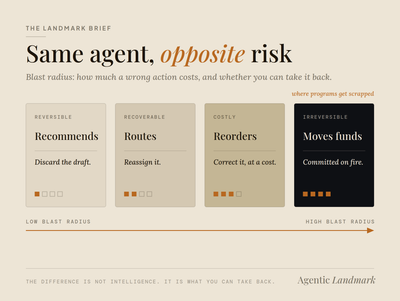
Over 40% of agent programs will be canceled by 2027. Blast radius decides which survive: how much a wrong action costs, and whether you can take it back.
Agentic Landmark · The Brief
Briefs on the infrastructure, authorization architecture, and commerce strategy of the agentic web: what brands need so agents can find, evaluate, and transact with them.
Over 40% of agent programs will be canceled by 2027. Blast radius decides which survive: how much a wrong action costs, and whether you can take it back.
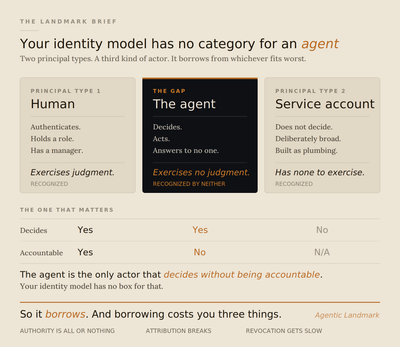
Pull the audit log for the last purchase order your agent placed. Whose name is on it? In most enterprises, the answer is a person, sometimes one who was on vacation that week. What the log will not say is that an agent did this.
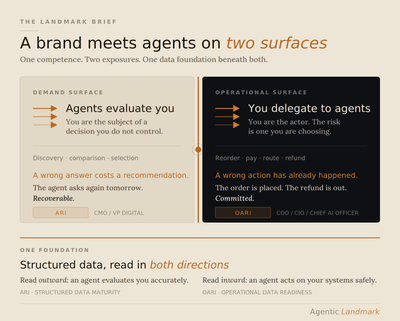
A demand-side agent that gets you wrong costs you a recommendation, and it self-corrects tomorrow. An operational agent that gets it wrong has already placed the order. Recommendations are reversible. Actions are not. Why agent readiness takes two instruments, not one.
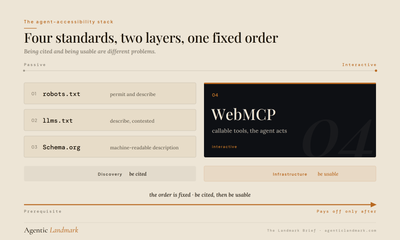
Most agent-ready advice collapses two different problems into one. Being cited and being usable run on different infrastructure, fail in different ways, and must be fixed in a fixed order. A map of the four-standard stack, from robots.txt to WebMCP, and why the sequence is the argument.
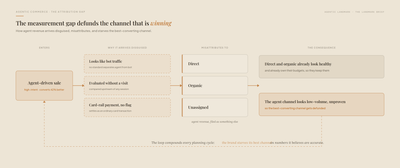
In March 2026, AI-sourced retail traffic converted 42% better than everything else. Now try to find it in your analytics. Agent revenue lands in direct, organic, and unassigned, so the best-converting channel looks unproven and gets defunded. Not a reporting problem. A budgeting problem.
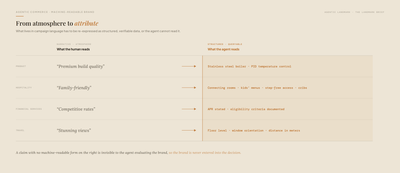
Every brand spent years learning to be memorable to humans. The next decade is about being legible to machines, not the same skill. A machine-readable brand is not good SEO or a chatbot. It is identity, claims, and offerings as structured data an agent can retrieve and reason from.
Contentful's Palmata makes one thing measurable: how answer engines represent your brand, past visibility into why and what to change. The measurement layer for AI discovery is now a category, not a feature. But it measures representation, not transactability, and that instrument does not exist yet.
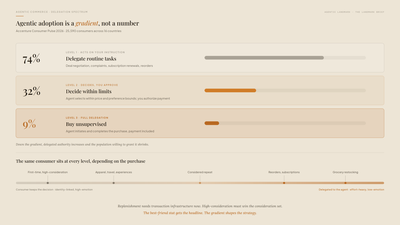
Accenture's best-friend stat will get the headlines. The 74-32-9 gradient underneath should shape strategy: 74% delegate routine tasks, 32% decide within limits, 9% buy without approval. Not one figure but three levels of authority, and the same consumer occupies each for different things.
Adyen Agentic removes the protocol-fragmentation bet: integrate once, and it translates your catalog across every agentic platform. The thesis is right, build for the layer, not the platform. But the layer solves integration, not data quality. A bad catalog gets distributed everywhere at once.
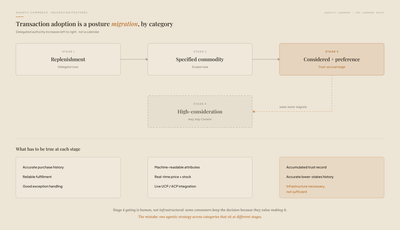
The agentic commerce conversation conflates two behaviors: using AI to discover and letting AI buy. Discovery is mainstream; delegated transaction is a fraction of it, because trust accrues on a schedule no announcement can rush. Adoption moves category by category, through four delegation postures.