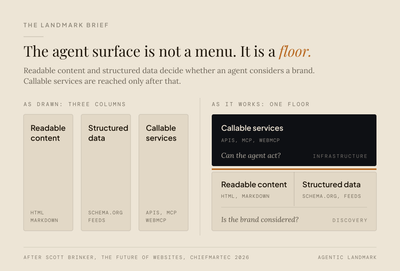
A dual-surface website still has an order
Scott Brinker’s dual-surface website is the right picture. But its agent half is a sequence, not a menu: discovery decides which brands an agent considers, and only then are a brand’s services called.
Agentic Landmark · The Brief
Briefs tagged two-layer-architecture in The Landmark Brief.
Scott Brinker’s dual-surface website is the right picture. But its agent half is a sequence, not a menu: discovery decides which brands an agent considers, and only then are a brand’s services called.
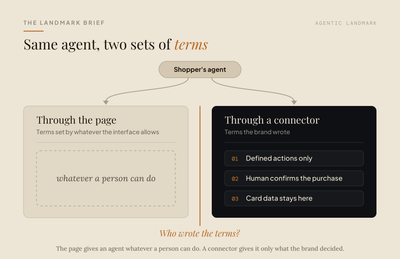
When an agent can use the page a human uses, the page is the only rule the brand wrote. Walmart has written its rules down. Most brands have not.
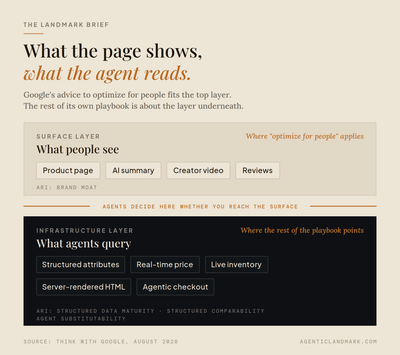
Google's holiday guidance tells retailers to optimize for people, not bots. Its other recommendations are all written for machines: richer product feeds, real-time price and inventory, agentic checkout. The contradiction resolves once you separate the surface layer from the infrastructure layer.
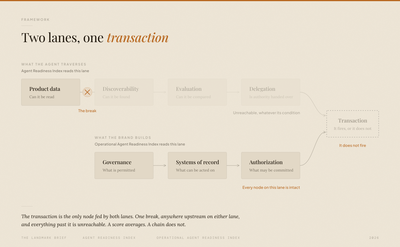
Both agent readiness instruments produce a weighted composite, and an average is a claim about the whole. A break is a claim about one link. Those do not commute. Why the score tells you what your exposure costs, and only an ordered read can tell you where you stop.
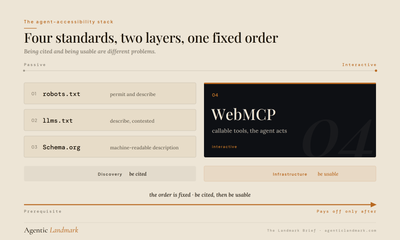
Most agent-ready advice collapses two different problems into one. Being cited and being usable run on different infrastructure, fail in different ways, and must be fixed in a fixed order. A map of the four-standard stack, from robots.txt to WebMCP, and why the sequence is the argument.