Everyone agrees agents will transact on consumers' behalf. Almost no one has mapped when, for what, and what has to be true first. Here is the timeline that matters.
The agentic commerce conversation has a consistent blind spot. Nearly every analysis conflates two different consumer behaviors: using AI to discover and compare products, and letting AI complete the purchase.
The first is already mainstream. A quarter of US online adults have used ChatGPT to search for products in the past month. The second delegated transaction, where the consumer does not click buy, is happening at a fraction of that rate, and the gap between the two is the most misunderstood dynamic in the category.
OpenAI launched Instant Checkout and pulled it within six months. The discovery volume was enormous. The transaction volume was not. That gap is not a failure of technology. It is a function of trust, and trust accrues on a schedule that infrastructure announcements cannot accelerate.
This article maps that schedule. Not with dates, dates are guesses, but with the sequence that actually governs when consumers will let agents transact, and the conditions that have to be true for each stage to arrive.
The unit of analysis is not the consumer. It is the consumer-category pair.
The central error in most adoption forecasts is treating "agentic commerce adoption" as a single number that moves over time. It is not. The same consumer will delegate a grocery reorder to an agent while insisting on personally choosing a mattress. Adoption does not happen consumer by consumer. It happens category by category, within each consumer, at different rates.
This is why the delegation posture framework is the right lens. Consumers are not Curators or Delegators as a fixed identity. They occupy different postures for different purchase categories simultaneously. The adoption timeline is the rate at which categories migrate from low-delegation postures to high-delegation postures, and that rate is governed by the characteristics of the category itself.
Four postures, in increasing order of delegated authority:
The Curator researches with AI assistance but makes every decision personally. The agent informs. The human decides and buys.
The Scoper sets parameters, price ceiling, preferred brands, specifications, and lets the agent build a shortlist or execute within those bounds, reviewing the result.
The Delegator hands off the entire transaction for defined categories within standing rules, reviewing exceptions rather than decisions.
The Orchestrator manages a portfolio of agents handling continuous commerce relationships, intervening only when the system surfaces something outside its mandate.
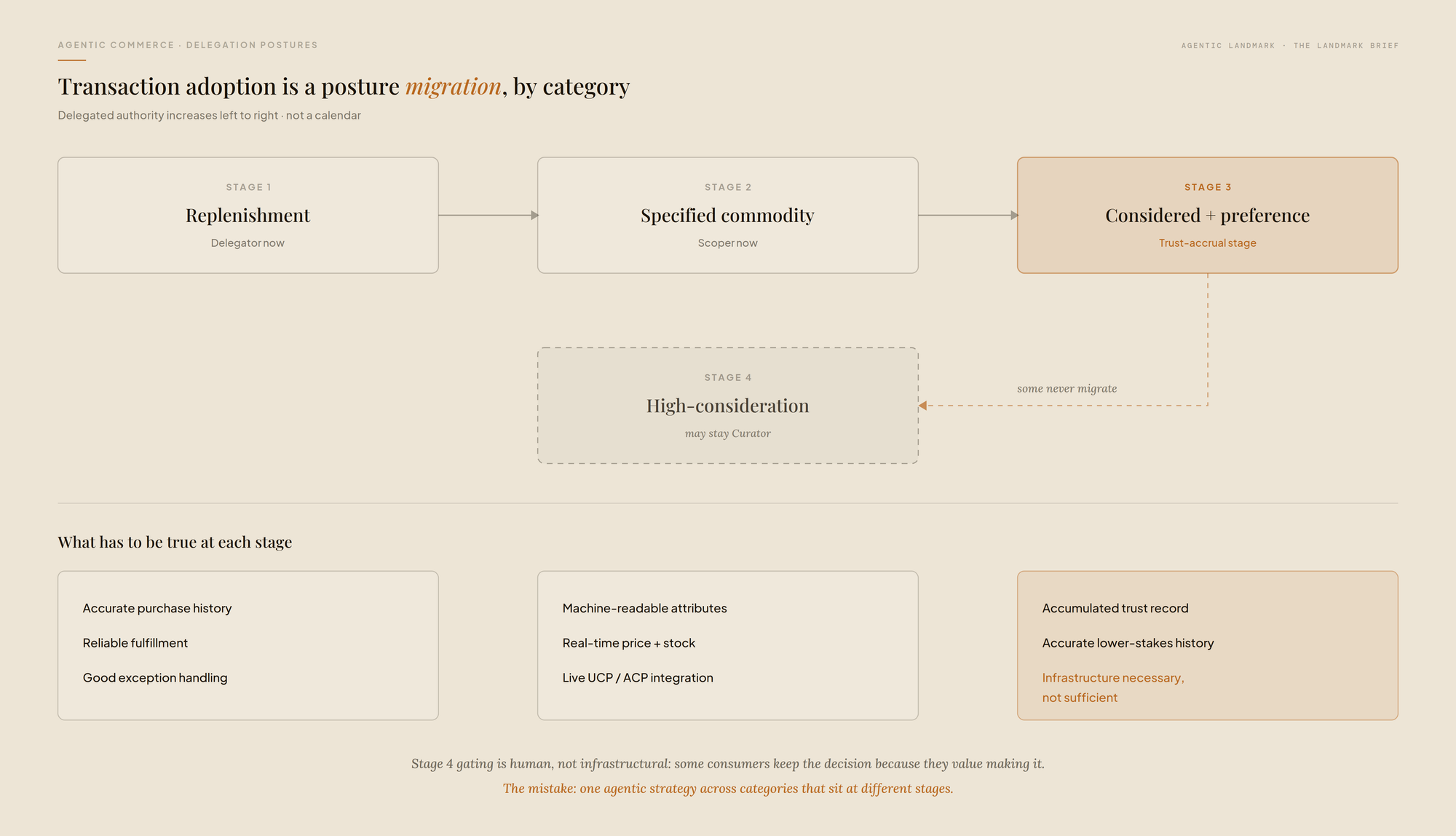
The transaction adoption timeline is the migration of categories through these postures. Here is the order it happens in, and why.
Stage one: replenishment and routine reorder
The first category to reach full delegation is the one where the decision was already made long ago.
Weekly grocery staples. Household consumables. Subscription restocks. Pet food. The purchases where the consumer already knows exactly what they want, has bought it many times, and experiences the act of buying as friction rather than choice. These purchases reach the Delegator posture first because the consumer is not giving up a decision they value. They are giving up a chore.
What has to be true for this stage:
The agent must have access to a purchase history accurate enough to reconstruct the standing order. The fulfillment must be reliable enough that an error does not break trust. The exception handling, what the agent does when an item is out of stock, must be good enough that the consumer is not surprised in an unwelcome way.
This stage is arriving now. It is the category where Walmart's Sparky, Instacart's agent integrations, and Amazon's replenishment infrastructure are already operating. The trust threshold is low because the stakes per transaction are low and the consumer's preference is already established.
Stage two: specified replacement and commodity purchase
The second category to migrate is the specifiable purchase, where the consumer knows the attributes they want but not necessarily the specific product.
The 18V cordless drill with a brushless motor is under $200. The replacement water filter that fits a specific refrigerator. The printer ink, the phone case, and the standard-specification item, where the consumer can articulate requirements precisely, and does not have a strong brand attachment that requires personal evaluation.
This reaches Scoper posture readily and Delegator posture for repeat instances. The consumer declares the specification and trusts the agent to match it. The migration is gated by the agent's ability to evaluate product attributes accurately against the declared specification, which means it is gated by the quality of the structured product data the agent can query.
What has to be true for this stage:
Brands need machine-readable product attributes complete enough for an agent to match against a specification. Inventory and pricing must be queryable in real time. The protocols that let the agent transact ACP, UCP must be live in the consumer's chosen platform. This stage is beginning now and accelerates as product data infrastructure matures across brands.
Stage three: considered purchase with established preference
The third category is the considered purchase, where the consumer has a formed preference, but the transaction stakes are high enough to warrant review.
The repeat apparel purchase from a known brand. The replacement of a product that the consumer has owned and liked. The upgrade within a product line they trust. Here, the consumer is willing to delegate execution but wants to review before commitment, because the purchase matters enough that an error has real cost.
This category reaches Scoper posture but resists Delegator posture longer. The consumer will let the agent assemble the purchase, but wants to approve it. The migration to full delegation depends on the accumulated trust the consumer has that the agent gets it right enough times to stop reviewing.
What has to be true for this stage:
The trust record has to exist. This is the stage where the compounding mechanism matters most. An agent that has executed lower-stakes purchases accurately builds the trust that lets a consumer extend authority to higher-stakes ones. The infrastructure is necessary but not sufficient. The differentiator is the behavioral history between the consumer and the agent.
Stage four: high-consideration and first-time purchase
The final category to migrate and the one that may never fully migrate is the high-consideration, high-stakes, taste-dependent, or first-time purchase.
The first espresso machine. The vacation. The car. The mattress. The purchases where the consumer does not have an established preference, where the choice expresses something about them, or where the stakes are high enough that the consumer wants to own the decision regardless of how capable the agent is.
These purchases stay in the Curator posture longest, and some stay there permanently. The agent will research, compare, build the consideration set, and surface the rationale. But the consumer makes the call. Not because the agent cannot decide, but because the consumer does not want to delegate this particular decision.
What has to be true for this stage:
This is less an infrastructure question than a human one. Some categories will migrate as trust accrues and as younger consumers who grew up delegating reach the life stages where these purchases happen. Others will resist indefinitely because the consumer derives value from making the choice. The error is assuming this category migrates on the same curve as the others. It does not.
What this means for brands
The adoption timeline is not a single curve. It is four curves moving at different rates, and a brand's position on each depends on the categories it sells into.
A brand selling replenishment-class products is already in the transaction-delegation era. The infrastructure investment agent-accessible checkout, real-time inventory, and structured reorder data is not a future project. It is a present requirement, and competitors who built it are already capturing delegated transactions.
A brand selling specifiable commodity products is entering stage two now. The gating factor is product data quality. The brands with complete, machine-readable, accurately structured attributes are being matched against consumer specifications. The brands without them are invisible to the agent doing the matching.
A brand selling considered purchases with established preference is in the trust-accrual stage. The infrastructure matters, but the differentiator is the brand's performance in the lower-stakes agent interactions that build the trust record. Every accurate fulfillment, every correct recommendation, every well-handled exception is an input to whether the consumer eventually delegates the higher-stakes purchase.
A brand selling high-consideration products should not be optimizing for full transaction delegation. It should be optimized to be the brand that the agent surfaces and explains when the consumer is making the decision personally. The job is to win the consideration set, not the delegated transaction.
The mistake to avoid
The single most expensive mistake in agentic commerce planning is applying one adoption timeline across a portfolio that spans multiple categories.
A retailer that sells both replenishment staples and high-consideration durables cannot run one agentic commerce strategy. The staples need a full transaction infrastructure now. The durables need discovery and consideration-set optimization with human-decision support. Treating them the same means either over-investing in transaction infrastructure for categories that will not use it, or under-investing for categories that already demand it.
The timeline is real. It is just not singular. The brands that map their own categories against the posture migration and invest according to where each category actually sits are the ones that will neither be caught unprepared nor waste capital building for a delegation that the category will not adopt.
Agents will transact on consumers' behalf. They already are, for some things. The question was never when agentic commerce arrives. It is which of your categories it has already arrived for, and which it never fully will.