Today's announcements aren't previews. They're production deployments. Here's what they actually mean.
Google published two blog posts today that, read together, represent the most consequential agentic commerce announcements since the category was named.
The first covers Search: AI Mode has surpassed one billion monthly users, with queries more than doubling every quarter. The Search box is getting its biggest upgrade in twenty-five years. Search agents are launching, information agents that monitor the web 24/7 on your behalf, agentic booking for local services, and a feature that lets Google call businesses on your behalf.
The second covers Shopping: a new Universal Cart, an expansion of the Universal Commerce Protocol to new surfaces and geographies, and the launch of the Agent Payments Protocol.
Most coverage will treat these as feature announcements. They are infrastructure deployments. Here is what actually matters.
The Universal Cart is the grant screen made practical
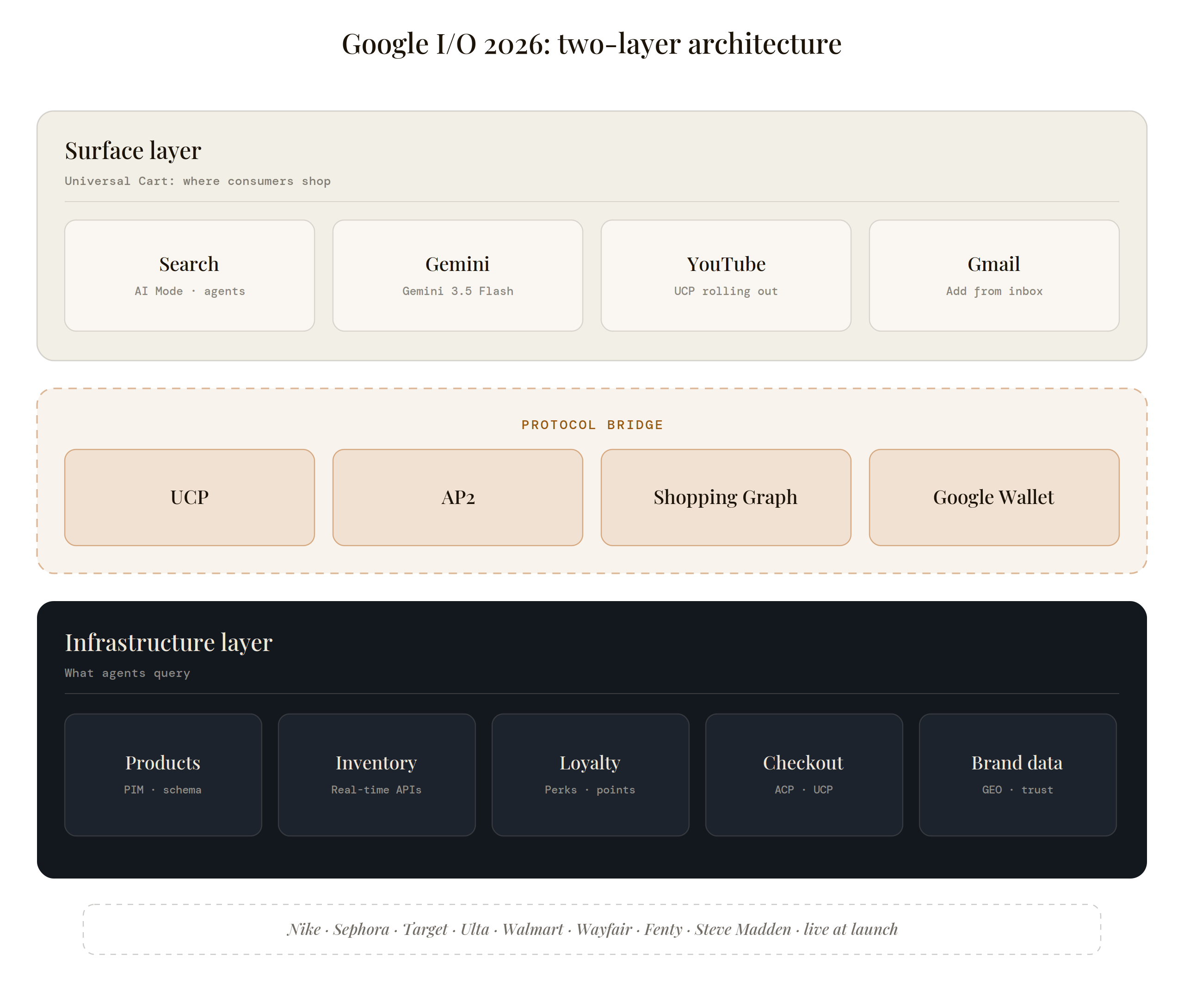
The Universal Cart is the first consumer-facing implementation of the delegation architecture that agentic commerce requires. It works across merchants and across surfaces, Search, Gemini, YouTube, Gmail as a single shopping context that follows the consumer rather than belonging to any one retailer.
But the feature that deserves the most attention is not the cross-merchant cart. It is the Agent Payments Protocol layer underneath it.
AP2 lets you set strict guardrails for agentic payment transactions. You declare the specific brands and products you want and the maximum the agent can spend. The agent only makes the purchase when your criteria are met. Under the hood, AP2 creates a transparent, verifiable link between you, the merchant, and the payment processor, using privacy-preserving technology to keep your data safe. Tamper-proof digital mandates ensure the agent is always acting on your behalf, giving you a permanent digital paper trail.
This is the grant screen. The consumer-facing authorization surface that defines what authority the agent holds, what it can spend, which brands it can transact with, and what constitutes a mandate violation. This infrastructure is the most consequential unbuilt surface in agentic commerce, which was announced today as a production feature shipping to Gemini Spark in the coming months.
The PC compatibility check example in the Universal Cart announcement is the clearest illustration of what this means in practice: if you're building your first custom PC and add a few parts from several retailers to your cart, your cart will proactively flag any product incompatibilities and suggest alternatives. That is an agent operating within a bounded mandate to buy parts for this PC build and exercising judgment within it. That is Scoper posture behavior running in production at Google scale.
The merchant list is the readiness signal
You can check out with Google Pay in just a few taps with many of your favorite brands, or transfer your items to the merchant's site to complete your purchase. You can try these select checkout features soon across merchants like Nike, Sephora, Target, Ulta Beauty, Walmart, Wayfair, and Shopify merchants such as Fenty and Steve Madden.
Read that list carefully. These are the brands whose infrastructure was ready. UCP integration, Google Pay compatibility, merchant-of-record preservation, and real-time catalog connectivity. Every brand on that list has done the infrastructure work required to be in the Universal Cart at launch.
Every brand not on that list has not.
No matter which way you buy, the brand stays the merchant of record. That detail matters for everyone watching the disintermediation question: Google is not inserting itself as the merchant. It is providing the interface, the protocol, and the payments infrastructure. The brands that have integrated remain the commercial entity in the transaction.
The brands that have not integrated are not in the transaction at all.
UCP is expanding faster than anyone has published
The Universal Commerce Protocol is not a US-only standard in pilot. We're expanding our UCP-powered checkout experience on Google to Canada and Australia in the coming months and later to the U.K. UCP is also coming to YouTube in the U.S., and to even more verticals, starting soon with hotel booking and local food delivery.
Three things worth noting in that sentence. First, geographic expansion to three major English-speaking markets within months. Second, YouTube as a commerce surface UCP-powered checkout inside video content. Third, vertical expansion beyond retail into hospitality and food delivery, which are exactly the high-frequency transaction categories where agent mediation compounds fastest.
The hotel booking expansion is the travel vertical signal. The brands building agent-ready infrastructure in travel loyalty data, inventory APIs, and real-time availability are now looking at a UCP-powered checkout surface launching on the world's most-used AI search platform.
Search agents are the Scoper posture at the population scale
The information agents announced today run continuously in the background, monitoring across the web for changes related to your specific question. If you're apartment hunting, you can brain dump all of the exact requirements you're looking for, and your agent will continuously scan for you, notifying you when listings meet your needs.
That is a consumer declaring parameters, size, location, price, amenities, and delegating continuous monitoring to an agent operating within those parameters. That is the Scoper posture. The consumer sets the scope. The agent executes within it. Exceptions surface as notifications rather than for every result.
The agentic calling feature takes it one step further. For select categories like home repair, beauty, or pet care, you can ask Google to call businesses on your behalf. A consumer who has delegated the call to Google has delegated a commerce action, inquiry, qualification, or potentially booking to an agent operating within their declared intent. The consumer never makes the call. The agent makes it and surfaces the result.
These are not experimental features. They are rolling out to everyone in the U.S. this summer.
What today means for brands
AI Mode has one billion monthly users with queries doubling every quarter. The Universal Cart is launching with Nike, Sephora, Target, Ulta, Walmart, Wayfair, and a selection of Shopify merchants. UCP is expanding to Canada, Australia, and the UK. AP2 is the authorization layer that makes consumer-controlled agent purchasing verifiable and defensible.
The infrastructure of agentic commerce is not being built. It is built. It is in production. It is rolling out to a billion users.
The readiness question for brands is no longer theoretical. The Universal Cart merchant list published today is the first public ranking of which brands are inside the agentic commerce infrastructure and which are not. The ShopTalk announcements of March were previews. Today's I/O announcements are deployments.
Three things every commerce brand needs to understand today:
The grant screen exists. AP2 is the consumer-facing authorization layer for agentic purchasing. The brands that are surfaced within that authorization layer, the ones consumers include in their declared brand preferences and spending parameters, have a structural advantage that compounds with every agent transaction. The brands not in a consumer's declared parameters do not get considered, regardless of their product quality.
The merchant-of-record model survived. Google is not the merchant. The brand remains the commercial entity. The brands that integrated with UCP and Google Pay preserved their customer relationships. The brands waiting for clarity on who owns the transaction no longer have that ambiguity. Today's announcement settled it.
The timeline moved. Information agents launching this summer. Universal Cart launching this summer. AP2 is coming to Gemini Spark in the coming months. The window between "interesting development to monitor" and "live infrastructure your customers are using" just closed for a significant portion of the market.
Correction, September 27, 2026. The opening said the AP2 authorization layer is shipping to a billion AI Mode users. The AP2 protocol specification was published in September 2025, but no product had shipped: Google announced AP2 for its own products "in the coming months, starting with Gemini Spark", as the body of this post says. This note corrects only the AP2 statement.