Every brand has spent years learning to be memorable to humans. The next decade is about being legible to machines. Those are not the same skill, and the brands that assume one produces the other are the ones agents will quietly route around.
A machine-readable brand is not a brand with good SEO. It is not a brand with a chatbot on its site. It is a brand whose identity, claims, and offerings exist as structured, verifiable data that an agent can retrieve, parse, and reason from without a human in the loop. Most brands are not this. They have spent their infrastructure budget on the human-attention layer and almost nothing on the machine-legibility layer, and the gap between the two is now a commercial exposure.
Here is the uncomfortable version of the problem. A challenger brand with a clean entity record, accurate attribute encoding, and strong presence in high-authority sources can have higher agent awareness than a category incumbent with decades of brand equity and no structured knowledge layer. The agent does not know who the market leader is. It knows what it can retrieve and verify. Brand equity that lives only in human memory and emotional association does not transfer to a system that has neither.
What being machine-readable actually requires, concretely:
An accurate entity. The brand has to exist as a correctly attributed entity across the structured sources that feed agent knowledge, Wikipedia, Wikidata, schema.org, the knowledge graphs agents query. A brand that is not a clean structured entity is not simply unknown to agents. It is inconsistently known, which is worse, because inconsistent entity representation produces inconsistent recommendations and factual errors that persist across every platform at once.
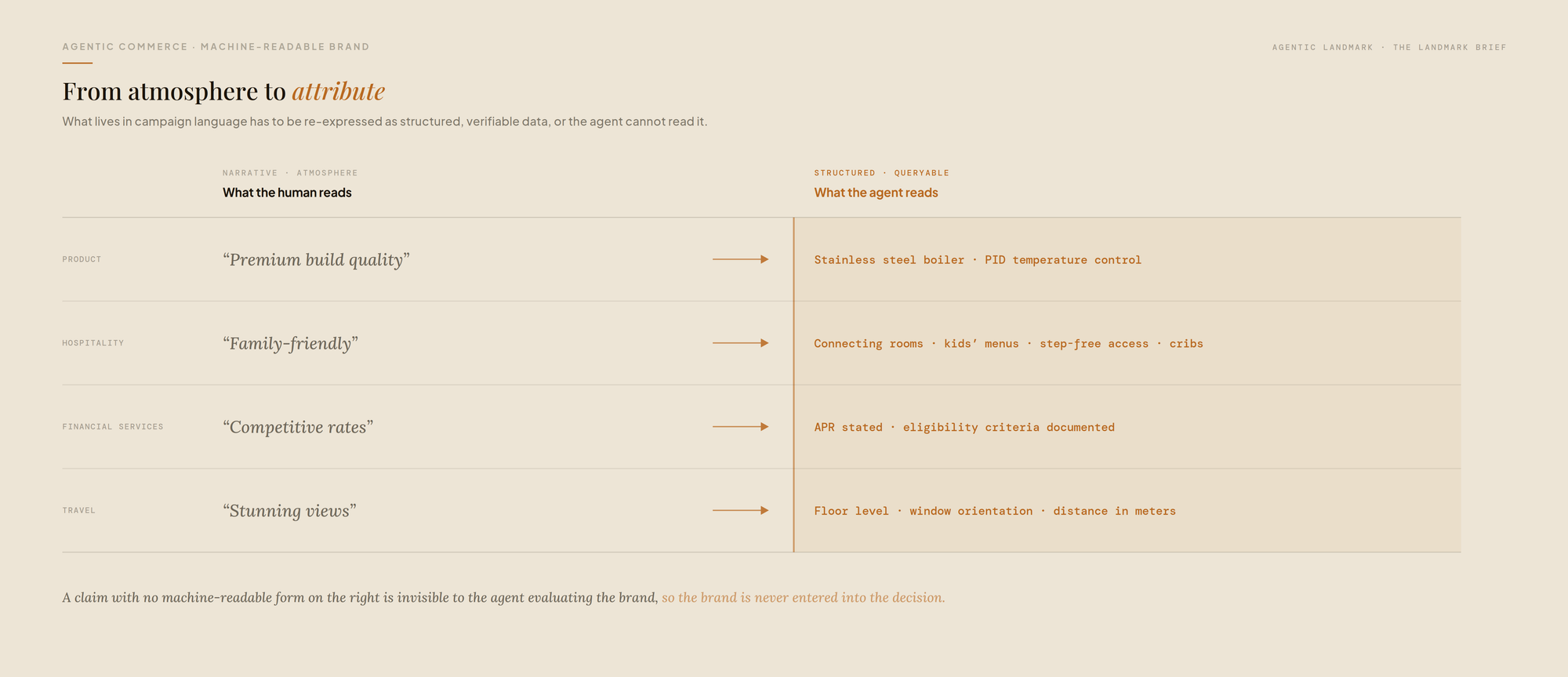
Positioning translated into structured claims. This is the part most brands underestimate. A positioning statement is a human-attention asset. It works because humans respond to narrative. An agent cannot retrieve "premium build quality." It can retrieve a stainless steel boiler with PID temperature control. The work of becoming machine-readable is translating every brand claim that currently lives in campaign language into a verifiable, structured, queryable attribute. Where a positioning claim has no machine-readable evidence behind it, that claim is invisible to the agent evaluating the brand.
Specificity where brands are used to atmosphere. Ravi Evani of Publicis Sapient put it precisely for hospitality: agents rank hotels not by slogans but by structured facts. Not "family-friendly" but connecting rooms, kids' menus, step-free access, cribs available. The same rule governs every category. In financial services, "competitive rates" is invisible; a specific APR and a documented eligibility criterion are not. In travel, "stunning views" is unquantifiable; floor level, window orientation, and landmark distance in meters are. Chris Riedy of Ibotta named the failure mode in one line: agents are not looking at display ads, they are looking at the inherent quality and metadata of the product, including its price.
This is one of the five dimensions the practice scores in its Agent Readiness Index, Structured Data Maturity. The diagnostic question it asks is not whether the brand is well known. It asks whether the brand's data and infrastructure are ready for machine evaluation, because a brand that scores low here cannot be accurately assessed by an agent even when the agent tries. Low maturity does not produce competitive loss. It produces misrepresentation and omission, which is the quieter and more expensive failure, because the brand never sees the transaction it was never entered into.
The reframe that matters for a CMO: being machine-readable is not a technical project you delegate to the data team and forget. It is a brand strategy question. The brand narrative your team spent years building has to be re-expressed in a form a machine can verify, or it does not exist in the channel where an increasing share of discovery and selection now happens. The story still matters for the human who reviews the agent's recommendation before committing. But if the agent could not read the brand in the first place, that recommendation was never made.
Being unforgettable was the last era's competitive advantage. Being machine-readable is this era's table stakes. The brands that understand the difference are already translating their equity into structured form. The ones that assume their reputation will carry them are about to discover that the agent has never heard of them.