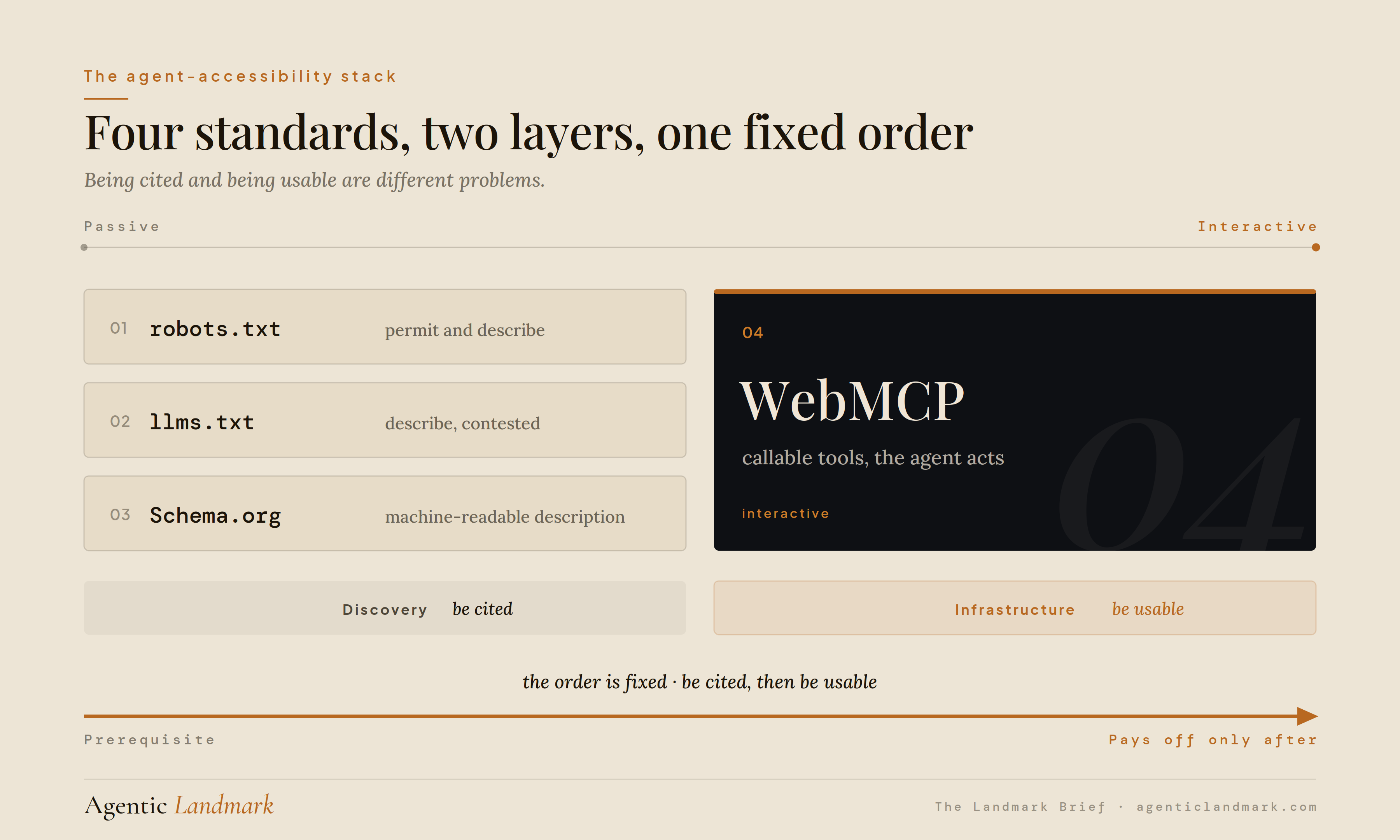
The category error underneath most agent-ready advice: being cited and being usable are two different problems, and readiness for one does not transfer to the other.
When an AI agent completes a task on your website, it does two separable things. First, it has to find you, which means being present in the answer the agent starts from. Then it has to act, which means doing the thing: filtering, comparing, adding to cart, checking out, on whatever surface you expose. Most advice about getting agent-ready treats these as one project. They are not. They run on different infrastructure, they fail in different ways, and the work you do on one buys you almost nothing on the other.
That is the category error worth naming before you spend a dollar on it.
The stack, from passive to interactive
There are four standards a brand can put in front of an agent, and they line up on a single spectrum from passive to interactive.
At the passive end sit robots.txt and llms.txt, two plain-text files that describe your site and tell crawlers and models what they may read. They are declarations. Nothing calls them. They sit there to be consulted, if anyone bothers.
In the middle is Schema.org structured data, the machine-readable description layer. It is how an agent knows that this string is a price, that one is a rating, and this block is a product and its variants. It is the difference between an agent reading your catalog and an agent guessing at it.
At the interactive end is WebMCP, and it is the genuinely new entry. WebMCP is a browser-native standard from Google and Microsoft, moving through the W3C, that lets a page declare its own callable tools: a search function, an add-to-cart function, a checkout function, with typed inputs an agent can invoke directly instead of screen-scraping your buttons. It is the browser-side counterpart to Anthropic's Model Context Protocol, the server-side standard that connects agents to backend systems. Where structured data lets an agent read your site, WebMCP lets an agent act on it.
The move from robots.txt to WebMCP is the move from here is what I am to here is what you can do. That shift is the whole story.
Two layers, not one checklist
The practice has a name for the split these four standards sit across: the two-layer architecture. There is a discovery layer, where an agent decides whether you are even in the consideration set, and there is an infrastructure layer, where the agent actually transacts. robots.txt, llms.txt, and Schema.org are mostly about the first. WebMCP is squarely the second.
This is not a semantic tidy-up. The two layers are owned by different teams, closed by different work, and measured by different numbers. Getting cited is a content-and-data problem: are you machine-readable, are you in the answer engines, does an agent see you when it builds its shortlist? Being usable is an interface-and-protocol problem: once an agent has chosen you, can it complete the task on your surface without falling back to brittle guesswork?
Readiness for one does not transfer to the other. A brand can be immaculately structured and cited everywhere and still hand the agent a checkout it cannot operate. A brand can expose perfect WebMCP tools and never get called, because it was not in the answer to begin with.
The order is the argument
Here is the part most coverage misses, because most coverage is technical-SEO how-to that treats the stack as a checklist to complete in parallel. It is not a checklist. It is a sequence, and the sequence runs in a fixed direction.
An agent's journey starts with a model's answer. The buyer asks the agent for a running shoe that fits their gait and their budget, and the agent produces a shortlist before it touches a single website. If you are not in that answer, nothing downstream matters. Your WebMCP tools are never invoked, because the agent never arrives. Citation is the prerequisite. It is the entry point to everything else.
Which is why the execution layer, for all that it is the exciting new thing, only pays off once the discovery layer is already true. Building agent-callable tools before you are agent-visible is building the second floor before the first.
But the inverse is a real failure too, and it is the one brands are sleepwalking into. Cited and not usable means the agent finds you, chooses you, arrives, and then cannot complete the task, so it routes around you to whoever it can actually transact with. You paid for the visibility and lost the sale at the last step. Both failure modes are live. Only the order in which you fix them is fixed.
What to actually build, and when
The honest guidance follows from the sequence, not from the newest standard.
Fix discovery first, because it gates everything and because most brands are not close. Adobe's 2026 data puts average product-page machine readability at 66 percent, with the weakest performers down near 54. The description layer, the boring middle of the stack, is where the real gap is, and it is the cheapest to close. And the citation channel is worth closing it for: Seer Interactive measured ChatGPT-referred conversion at 15.9 percent against 1.76 percent for Google organic, in a single B2B software case study covering October 2024 to April 2025. The conversion action was a signup rather than a purchase, so the ratio is a directional signal about the citation channel rather than a merchant benchmark.. Being in the answer is not a vanity metric.
Then, and only then, invest in execution. Here is a note of restraint the how-to pieces skip: WebMCP is early. It is in a Chrome origin trial, native support in other browsers is unconfirmed, and a formal web standard is years away, not months. That is a reason to understand the architecture and watch the trial, not a reason to rush a build. The brands already in the trial are the ones agents most need to transact with, in travel, retail, and financial services, which tells you where this lands first. It does not make it production infrastructure yet.
One more piece of restraint, at the passive end: do not overweight llms.txt. Google's own John Mueller called it purely speculative in mid-2026, because no major AI system actually consumes it. A file nothing reads is not a readiness layer. Spend the structured-data effort where agents are demonstrably looking.
The sequence, stated plainly
Citation gets you into the answer. Execution gets you acted upon. Both require work now, but the second is worth nothing until the first is true, and no amount of the first survives a broken second.
So the question to bring to your own site is not are we agent-ready, which flattens two problems into one and usually gets answered by whoever owns the newest acronym. It is two questions, asked in order. Are we in the answer. And when the agent arrives, can it do the thing? A brand can be perfectly cited and completely unusable, or perfectly usable and never cited. Both of those brands lose. The one that wins fixes them in the order the agent experiences them.
Correction, August 30, 2026. This post originally cited the Seer conversion figures without their basis. The source is a single B2B software client, October 2024 to April 2025, roughly 1,370 AI conversions against approximately 14 million organic sessions, and the conversion action is a signup rather than a purchase. The figures are unchanged; the framing is corrected.
Correction, September 27, 2026. The August 30 correction above, and the body text it describes, describe the Seer client as a B2B software company and its conversions as sign-ups. Seer's published case study states neither: it names no sector and counts "key events". The figures stand: 15.9 percent against 1.76 percent for Google organic, from a single Seer client, October 2024 to April 2025, with roughly 1,370 AI conversions against almost 14 million organic sessions.