Google told brands that AI visibility is a content discipline, then published a case study describing an infrastructure one.
The claim, and who is making it
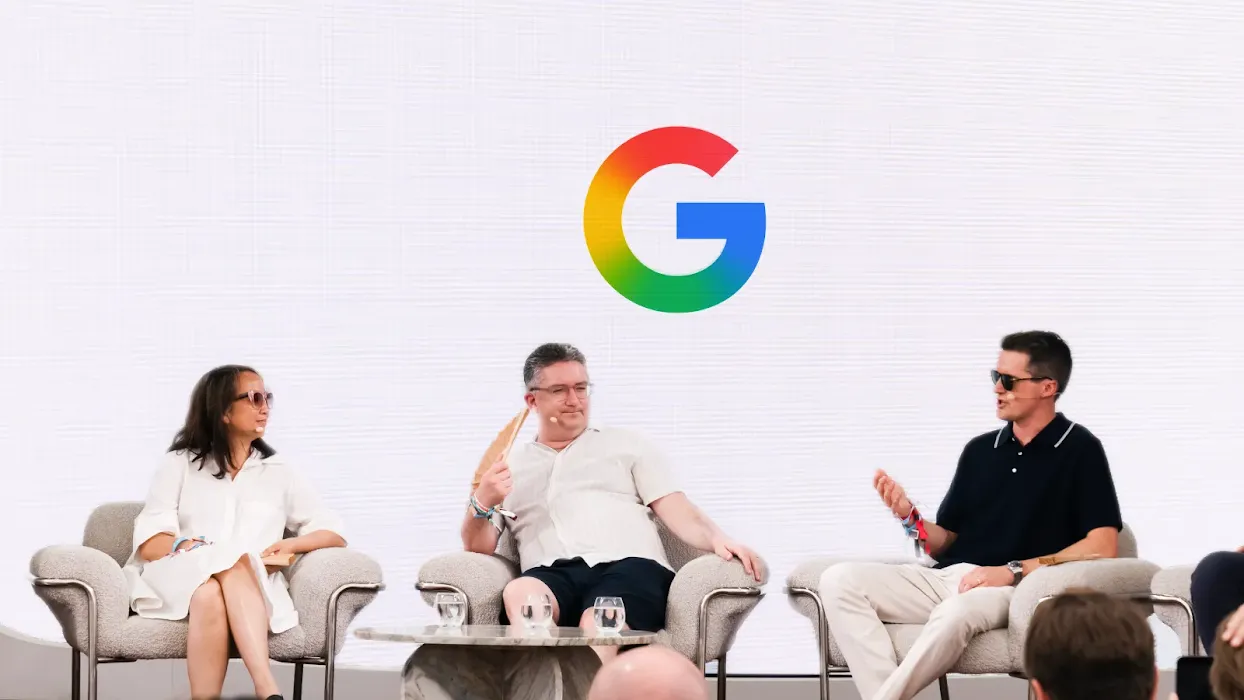
In August, Think with Google published a panel from Cannes featuring Linda Ha, deputy CMO of Ikea, Dan Finley, group CEO of Debenhams Group, and Andy Wells, VP of growth marketing at DoorDash. One section runs under the header "Good SEO is good GEO." The framing throughout is that foundational search engine optimization remains the best formula for organic discoverability as search becomes conversational and agentic. The piece closes by instructing readers to audit their search architecture for AI readiness and to move more budget into AI-powered campaigns.
The advice is not wrong. It is incomplete, and the incompleteness runs in the direction of the publisher's interest. This is Google's publication, Google's event, Google's stage, and Google's ad products. That does not make the claim false. It makes it a claim that requires an independent test, and the article supplies none. Its own footer notes that results vary by advertiser.
The test is available anyway. It is sitting in the article.
Read the example
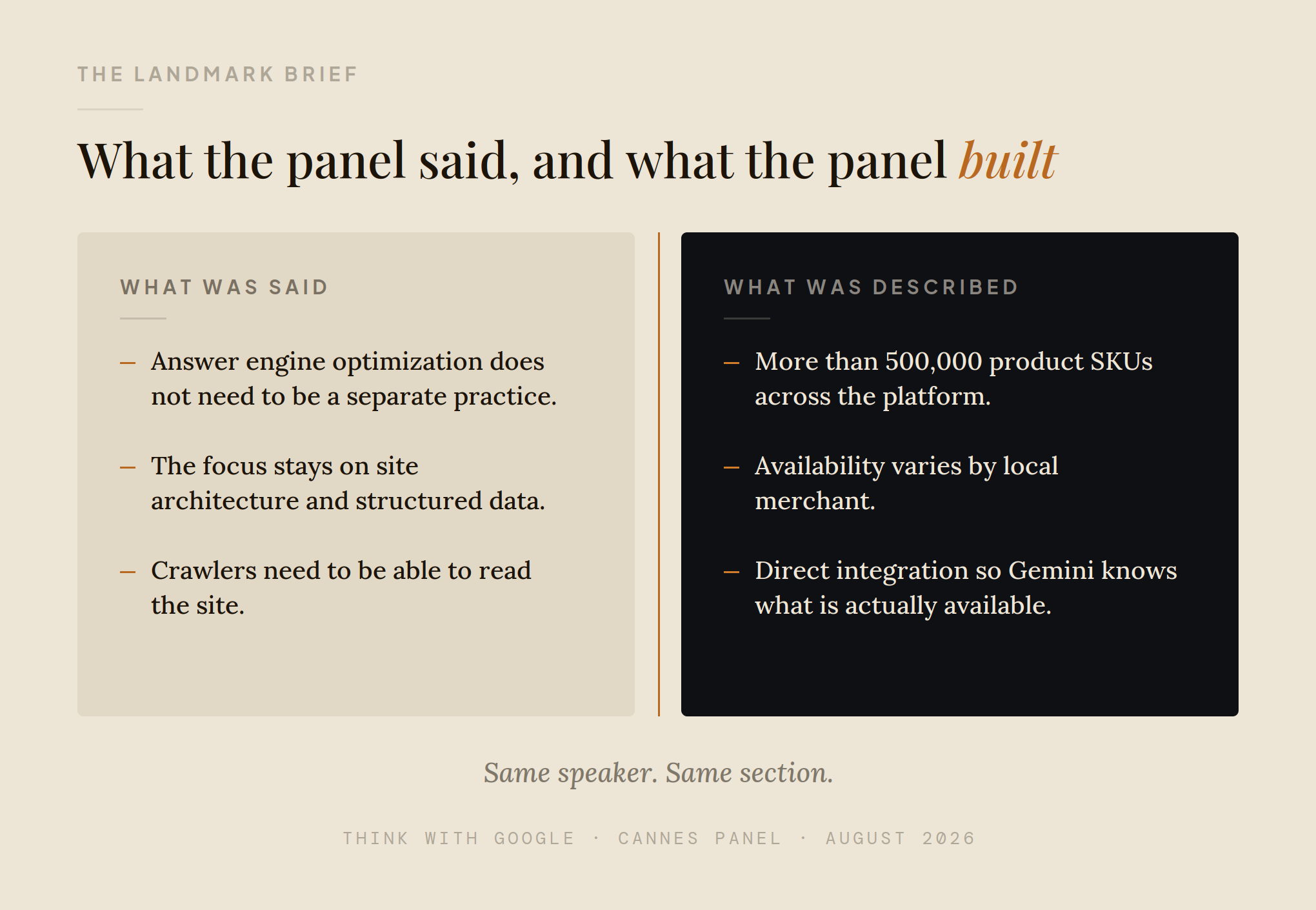
Wells states the thesis most directly of the three. He says the notion that answer engine optimization must be an entirely separate practice from SEO is a misconception, and that DoorDash has stayed focused on site architecture, structured data, and making sure crawlers can read the site.
Then he describes what DoorDash actually built.
The platform carries more than 500,000 product SKUs. Availability varies by local merchant: a given item is stocked at some and not at others. DoorDash integrates directly with Google so that Gemini and AI Overviews can read that catalog and understand when to recommend DoorDash, or a specific product, based on what is actually available.
That is not SEO.
Sitemaps, canonical tags, heading hierarchy, internal linking, and crawl budget do not solve merchant-level availability across half a million items. What solves it is a feed. An identity scheme that keeps a product the same product across merchants. An availability signal that is true at query time rather than at publish time. A direct integration path to the platform doing the reading, with a contract about freshness. Those are supply-side data commitments owned in engineering and operations. They are not a content team's backlog, and no amount of technical SEO maturity produces them.
The panel's own worked example refutes the panel's own headline. You do not have to argue with Google here. You have to read closely and point.
The two layers, named
The confusion is real and it is worth naming precisely, because both layers are genuinely required and they are genuinely different.
Layer one is whether an agent can find you and cite you. That layer is substantially continuous with SEO. Crawlability, clean markup, server-rendered content, schema, and third-party corroboration all carry over. Google is right that the fundamentals did not stop mattering, and the practitioners who declared SEO dead in 2025 were wrong.
Layer two is whether an agent can resolve, compare, and act on your catalog with enough confidence to name a specific item to a specific person in a specific place. That requires structured product data that is machine-comparable against competitors on the attributes the agent is reasoning over, and that stays true as inventory moves. In ARI this is Structured Comparability and Structured Data Maturity, and they are scored separately from anything a content audit touches.
Ha makes the same point from the other side without naming it. Ikea, she says, has to stay on top of what other sources say about the brand, and works across paid, owned, and earned to shape that. Third-party representation is not a property of your website either. It is not something a sitemap fixes.
Good SEO gets you into the answer. Structured, resolvable, availability-true product data gets you named inside it. The first is necessary. It is not sufficient, and treating it as sufficient is how a brand spends a year on content operations and cannot explain why agents still recommend a competitor.
The admission in the third section
The most valuable sentence in the piece is not about search at all.
Wells says DoorDash can no longer rely on click-based attribution as discovery behavior shifts, and has moved to incrementality experiments, measuring incremental gross order value rather than attributed conversions.
That is Measurement Readiness, conceded by an operator rather than asserted by an analyst.
Measurement Readiness sits outside ARI's five scored dimensions on purpose. It does not measure agent exposure. It measures whether a brand can observe its own exposure in its own numbers. A brand that fails it cannot tell whether its AI search work did anything, or whether the quarter moved for unrelated reasons, and will keep funding whatever its instrumentation happens to be able to see. That is not a reporting inconvenience. It is a capital allocation defect.
Notice the sequencing. The same operator who says AEO is not a separate discipline also says his attribution cannot see the behavior he is optimizing for. Both statements are true. Together they describe a company doing serious infrastructure work it does not yet have a name for, measured by an apparatus it has already outgrown. Most brands are in the same position without the first half.
The door nobody opened
DoorDash also shipped Ask DoorDash, a conversational assistant that will take a recipe link or a photo of a cookbook page and assemble a full shopping cart.
On the demand side that reads as a feature. On the supply side it is an operational agent assembling a commitment against a catalog where availability varies by merchant. The failure mode is a cart of items that are not there, produced at scale, in front of a customer, by the brand's own system. That is blast radius in the OARI sense, running on exactly the same catalog data the Gemini integration depends on.
One dataset. Two exposures. Only one of them was discussed at Cannes.
What the audit should actually cover
Google's closing instruction is the right instruction. The question is scope. An audit that stops at crawlability will pass a brand that is structurally invisible to an agent making a recommendation.
Five things belong in it that a technical SEO audit will not reach:
Whether product attributes are comparable against competitors on the dimensions an agent reasons over, not merely present on the page. Whether product identity resolves consistently across every surface where the catalog appears. Whether availability and price are true at the moment of the query rather than at the moment of publication. Whether the brand has an integration path to the platforms doing the reading, or is relying on being crawled. And whether anything in the analytics stack can detect agent-mediated demand well enough to tell you if the other four worked.
The last one gates the other four. A brand that cannot measure the exposure cannot govern the response to it, and will conclude that the work did not pay off because the instrumentation could not see that it did.
Audit the architecture. Just make sure the architecture you audit is the one agents actually read.
 Think with Google Editorial Team