An industry is being told to build a capability around optimizing a number that moves several-fold depending on which tool produced it.
McKinsey published a finding in June, in State of the Consumer 2026, that should worry anyone selling AI visibility. In consumer goods, brand-owned websites account for one to two percent of the sources large language models cite. Not one to two percent of traffic. One to two percent of the material a model is reading when it forms an answer about your brand.
The prescription follows immediately, and it is the one everybody is giving right now. Generative engine optimization is the new search engine optimization. If the models are not reading your site, go influence what they are reading. Strengthen public relations. Seed the review sites. Show up in the communities. Get consistent across platforms you do not own.
The finding is real, and the direction is right. The prescription is where I would stop.
The measurement is better than most and still moves
Start with what makes this study worth taking seriously, because most numbers in this category do not survive the first question.
The June figure rests on roughly 2.6 million citations, drawn across 25 consumer packaged goods brands, spanning 89,119 unique domains in the UK and US, over October 2025 through May 2026, aggregated across ChatGPT, Gemini, and Perplexity. That is a real sample, and McKinsey published the parameters in the exhibit rather than burying them. Most of what gets quoted at conferences this quarter has none of that.
Now look at what the exhibit actually shows. It is broken out by platform, and the one to two percent is a range across those three models. Look at the top ten cited sources and the same brand-owned share runs from three percent to ten percent, again depending on which model you ask.
Same vendor. Same window. Same 25 brands. Same 2.6 million citations. A threefold spread produced by nothing except platform mix.
If your monitoring vendor weights Perplexity more heavily than mine does, our numbers diverge threefold before either of us has made a mistake.
Two numbers, eight months apart
That is the variance inside one study. Between studies it is worse.
In October 2025, in New front door to the internet, McKinsey published that a brand's own sites comprise five to ten percent of the sources AI-powered search references, from Google AI Overview data combined with the firm's own analysis. In June 2026, the same firm published one to two percent, from a vendor dataset.
Same organization. Eight months apart. A five-fold difference in what reads, to anyone skimming, like the same quantity. No reconciliation offered, and no reference in the second piece to the first.
I do not think either is an error. The two figures answer different questions that happen to sound identical. One counts sources referenced by AI-powered search, anchored to Google's AI Overview surface. The other counts citations across three named models. One spans categories. The other is scoped to consumer goods. Change any one of those and the number moves. Change all of them and a five-fold gap is unremarkable.
Ask a simpler question and the same problem appears. What counts as a citation? A named link in a footnote is one. Is an unlinked brand mention in the body of an answer? A paraphrase of your product page that names no source? Your own copy appearing because a retailer syndicated it? Every monitoring product has an answer; none of them publish it, and the answers are not the same.
Who supplied the measurement
One more thing worth stating plainly, because I have not seen anyone else say it.
The vendor behind the June figure sells generative engine optimization monitoring. The same statistic is the lead hook on its own homepage. The party supplying the measurement also sells the remedy the measurement implies.
That does not make the data false. Vendor telemetry is frequently the only telemetry that exists in a new category, and a firm that publishes with it and names it is being more transparent than one that does not. Adobe sits in the same position with its machine-readability benchmarks, which arrive alongside a product Adobe sells for improving machine readability.
But the finding is not independent of the conclusion it supports, and that is worth knowing before a number becomes a budget line. Anyone quoting the one to two percent should be naming the vendor in the same breath. I now do.
What survives the disagreement
Strip out everything unstable and something solid is left standing.
Both readings, five to ten percent and one to two percent, say the same thing about direction: the overwhelming majority of what models read about your brand is not written by you. Whether it is ninety percent or ninety-nine percent does not change a single decision a brand would make. That finding is robust across instruments, and it is genuinely important.
What does not survive is the use the finding is being put to.
You cannot optimize toward a target you cannot measure twice. If your agency reports your citation share at four percent and a competitor's vendor reports theirs at eleven, you have learned nothing about either brand. You have learned that two instruments disagree. A number that moves threefold on platform mix alone, and five-fold across published studies, can support a trend line inside a single frozen instrument. It cannot support a level, a benchmark, or a comparison.
That is a constraint, not a reason to stop measuring. Fix your instrument, name it every time you report a figure it produced, and read your own movement over time. What you give up is the industry benchmark, and the industry benchmark does not currently exist, no matter who is selling you one.
The layer you can actually measure
Here is the part that made me want to write this down.
The prescription on offer is to influence the corpus. Spend on public relations, on reviews, on community presence, on consistency across platforms you do not own. It is not bad advice. It is also a permanent operating expense, applied to a surface you cannot audit, verified by a metric that will not hold still.
Compare that to the other layer.
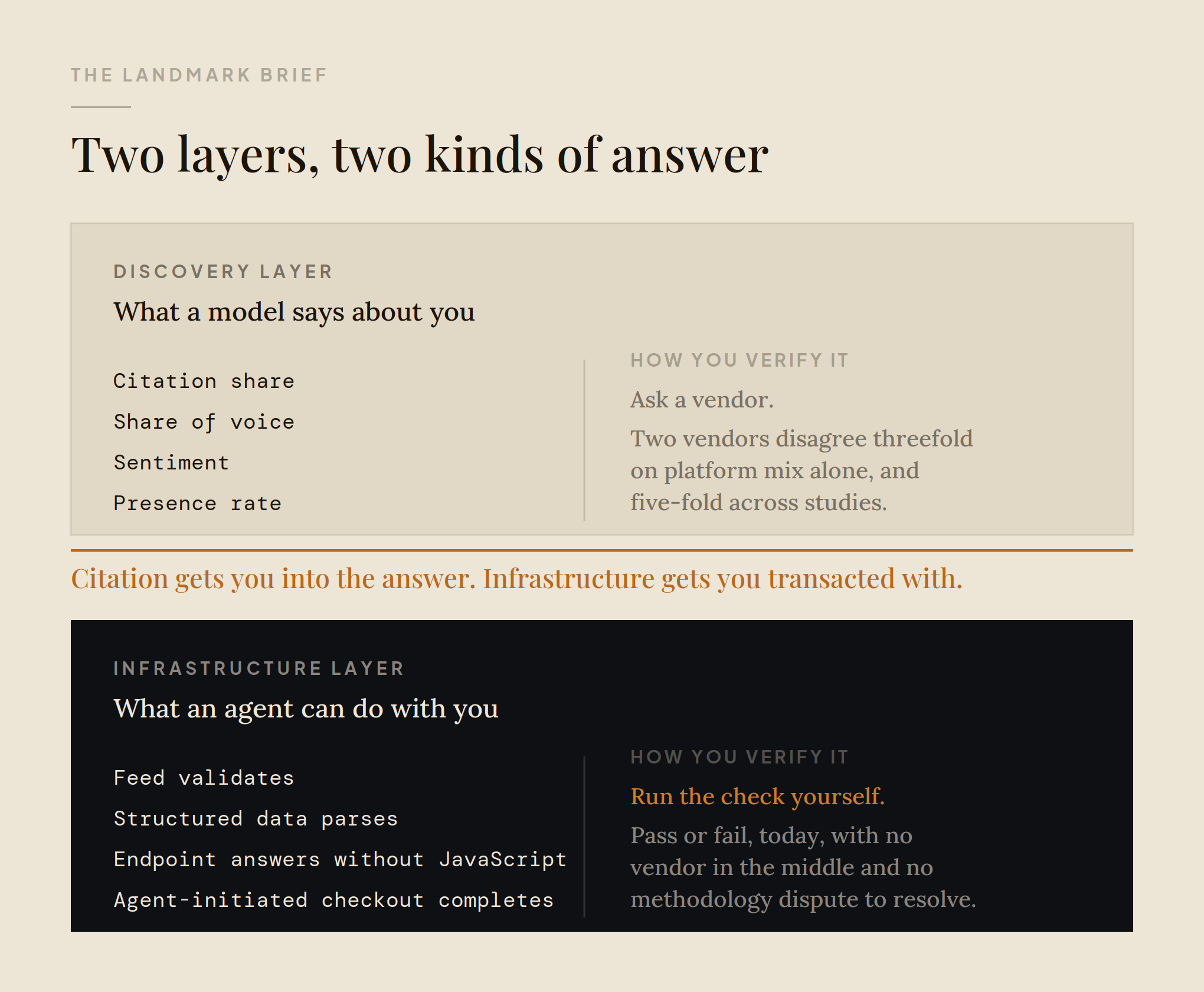
Whether your product feed validates is a fact. Whether your structured data parses is a fact. Whether your pricing and availability are reachable by an agent that does not execute JavaScript is a fact. Whether your checkout can complete a transaction initiated by something that is not a browser is a fact. Every one of those is verifiable by you, today, with no vendor in the middle and no methodology dispute to resolve.
The discovery layer and the infrastructure layer have never been equally measurable, and I do not think the industry has noticed. Nearly all the attention and nearly all the spend is going to the layer where the numbers are contested, produced by interested parties, and unstable across instruments. Meanwhile, the layer that determines whether an agent can transact with you at all returns a clean pass or fail on every check.
Citation gets you into the answer. Infrastructure gets you transacted with. Both matter, and the second one is the only one you can currently prove you have done.
Structure survives a corpus you do not control. Seeded content does not.