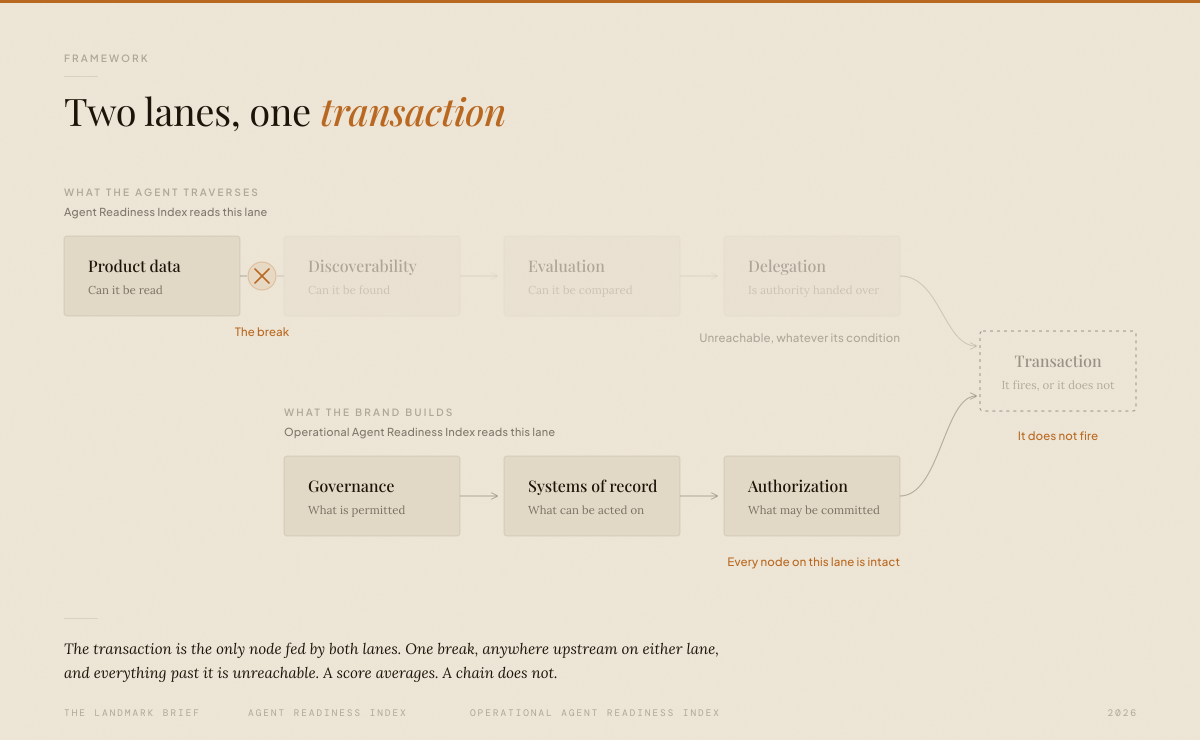
Both instruments produce a weighted composite and a composite average, which is the one thing an ordered dependency refuses to do.
Score a company on operational agent governance, and you can get a strong result. Policy is written. Escalation triggers are predefined. Every deployed agent has a named human with authority to pull it. On the instrument that measures those things, this company is in good shape, and it should be, because that work is expensive and most companies have not done it.
Now ask whether an agent shopping on behalf of a consumer can read this company's product data accurately enough to put it in a comparison set.
It cannot, because the catalog was written for humans.
The governance work was not wasted. It is also, for agent-mediated buying, never exercised. And here is the part that should bother you: both of that company's scores are defensible. Neither one is capable of telling it what just happened.
The order runs on both sides
Two briefs in this series have already laid most of the groundwork, and it is worth being precise about which part each one built.
Being cited is not being usable argued that the agent-accessibility stack is a sequence rather than a checklist, and that the order is fixed: if you are not in the answer, the execution layer you built is never invoked. When you deploy the agent, you own the mistake argued that a brand is exposed to agents from two directions, that the two exposures have different physics, and that one instrument stretched across both goes vague about both.
Put those together and something is missing between them. The first brief established an order, and every layer in it faces outward. The second established a second surface, and described it as a surface: parallel, differently governed, differently owned. It never asked whether that surface has an order of its own.
It does, and most companies have it drawn backwards.
Governance is not the mature state you arrive at after the technical work. It is the substrate. Policy comes first, because it determines what any system is permitted to do at all. Systems of record come next, because they determine what an agent can act on and whether the copy it reached was the authoritative one. Authorization comes last, not because it matters least but because it is the gate immediately before the commit: the per-workflow decision about what this agent may execute, what it must send for approval, and what it must escalate.
Run in that order, the operational side is not a surface sitting alongside the demand side. It is a second-order dependency, and it points somewhere specific.
Both orders end in the same place
The demand order terminates at the transaction. So does the operational one.
That is the whole structural claim, and it has a consequence neither prior brief could reach. The transaction is the only point in either sequence that depends on both. Everything upstream on the outward-facing side has to hold for an agent to arrive and select you. Everything upstream on the inward-facing side has to hold for your own systems to complete what it started. The two sequences do not run in parallel forever. They converge.
Which means the two exposures are not merely different in physics. They are joined, at exactly one point, and it is the point that makes money.
A company that has built nothing operationally can be found, compared, and chosen, right up until something has to be committed on its side. A company that has built nothing on the representation side can hold immaculate authorization boundaries that no agent ever reaches. Neither company is partially ready. Each is stopped, at a specific link, for a specific and entirely different reason.
They present identically. Both look like a transaction that did not happen, which is the least diagnostic symptom available, and a company reading one instrument will find a plausible story on the side it can see.
A composite averages; an order does not
Now the tension that has been sitting under both instruments since the second one was built.
The Agent Readiness Index and the Operational Agent Readiness Index both produce a weighted composite. Five dimensions, weights, a number, a band. That is the correct shape for what they measure, and averaging is not a flaw in them. It is what lets a number describe a whole position at once and lets a board compare this quarter to last.
But an average is a claim about the aggregate, and a break is a claim about one link. Those do not commute. Strength downstream cannot compensate for a break upstream, because downstream is never reached, and any instrument that sums across dimensions will quietly let a strong result in four places offset a stopping condition in the fifth. The composite is not lying. It is answering a different question than the one the company asked.
The company at the top of this brief does not have a mid-range readiness position that its governance work partially offsets. It has a stopping condition, on one side, at one link, and a fully built lane on the other side that nothing will arrive on until the first is fixed.
What each one is actually for
The resolution is not to abandon the score. It is to stop asking it a question it was never built to answer.
The ordered read locates the break. It is a per-link diagnostic with a near-binary answer: does the agent get through here? It tells you what to fix first and, more valuably, what not to fix yet. Almost nobody runs it, because it produces no number and nothing to put on a slide.
The score measures exposure. Once the sequence carries traffic, it tells you how much revenue is sitting on the far side of a dependency you do not control, which is the question a board asks, and the question a per-link diagnostic cannot answer.
Most companies are running the second exercise without having run the first. They are improving dimensions on a sequence that terminates in a broken link several steps upstream. The improvement is real, it is measurable, it moves the composite, and none of it reaches the transaction.
Find the break. Then measure what it costs you.