Everything I have written in this series has been about agents you do not control.
Agents that shop you. Agents that read your product data and decide whether you make the shortlist. Agents that mediate the moment a customer used to spend on your site. Thirty-eight briefs on discovery, structured data, protocol integration, and what happens to a brand when the buyer stops browsing and starts delegating. All of it about a force arriving from outside, doing something to you.
That is half the problem. I want to write about the other half, because the other half is the one that can actually cost you money this quarter.
Two surfaces, not one
A brand today is exposed to agents from two directions at once, and the two exposures are not the same problem wearing different clothes.
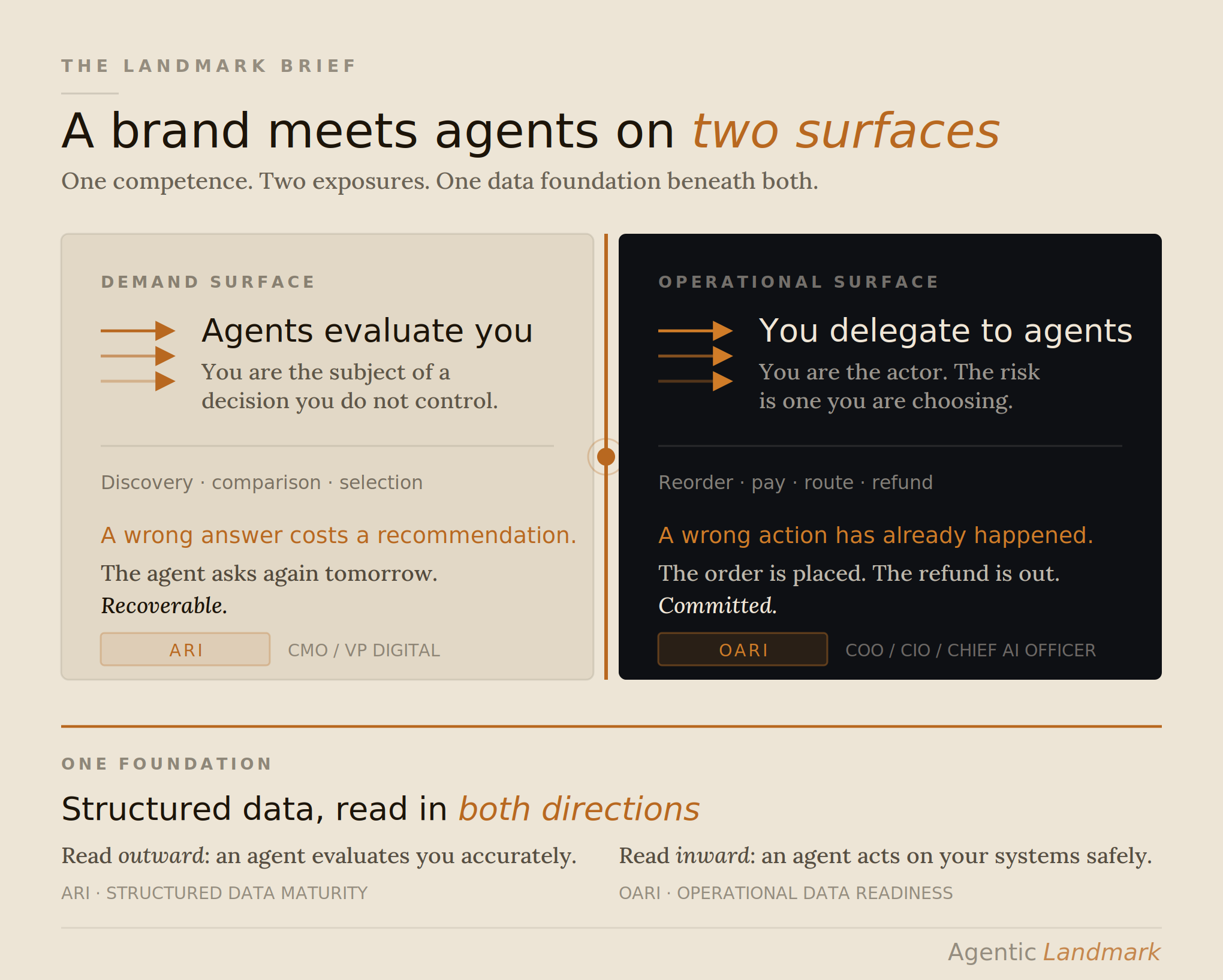
On the demand side, agents mediate discovery and selection. You are the subject of a decision you do not control. An agent builds a comparison table, and you are either in it or you are not. The question is whether agents can find you, evaluate you accurately, and choose you. This is the surface the Agent Readiness Index scores, and it is the surface this series is exploring.
On the operational side, you are not the subject. You are the actor. You are the one deploying agents, inside your own operations, against your own systems, with your own authority. An agent reorders inventory. An agent acknowledges a purchase order. An agent routes a shipment, or issues a refund, or decides whether a returned unit is resold or scrapped. The risk here is not something happening to you. It is something you are choosing.
Same word, "agents." Different physics entirely.
The asymmetry that makes this urgent
Here is the part that should change how you sequence your investment.
A demand-side agent that gets you wrong costs you a recommendation. That is real money, and I have spent thirty-eight briefs arguing it is worth taking seriously. But it is also self-correcting. The agent asks again tomorrow, and if your data is better, you win the next comparison. The failure is recoverable because the failure is a decision that did not go your way.
An operational agent that gets it wrong does not cost you a recommendation. It places the purchase order. It issues the refund. It commits the supplier. By the time anyone notices, the thing has already happened, and the question is no longer whether you will be selected. It is whether you can unwind what your own system just did in your name.
Recommendations are reversible. Actions are not.
This is why the failure numbers on the operational side are so much uglier than the discourse suggests. Gartner projects that over 40% of agentic AI projects will be scrapped by the end of 2027 (Gartner, 2025). Read that carefully, because the interesting part is not the percentage. It is the cause. These programs are not failing because the models are not good enough. They are failing on governance: agents deployed before anyone defined what they were allowed to do, what data they needed to do it reliably, and how a failure gets caught before it compounds.
Nobody scraps an agent program at the pilot. They scrap it after scaling exposed what the controls could not hold.
Why one instrument cannot cover both
The temptation, once you see the second surface, is to reach for the instrument you already have and stretch it. Resist that.
An instrument built for demand-side exposure asks questions like: how dependent is your discovery on channels you do not own, how comparable is your product against alternatives, how substitutable are you in an agent's judgment. Those are the right questions for a brand that is the object of an agent's decision.
They are the wrong questions entirely for a COO whose agents are placing orders against an ERP. That person does not need to know their traffic dependency. They need to know whether their authorization model can express what an agent may do per workflow, or whether it grants an agent everything its role can do. They need to know what the worst realistic outcome of one wrong action is, and whether it can be reversed. They need to know whether they would even see an agent misbehaving, or only find out downstream when the damage surfaced.
Stretch one instrument across both surfaces and you get an instrument that is vague about both. The sharpness is the value. A diagnostic that asks a manufacturer's COO about their GEO investment is not being thorough. It is being useless, and it will tell them, incorrectly, that they are fine.
So: two instruments. The Agent Readiness Index for the demand surface. The Operational Agent Readiness Index for the operational one. Different dimensions, different weights, different buyer, different questions.
The seam where they meet
Two instruments, but not two problems. They rest on the same foundation, and once you see the seam you cannot unsee it.
The demand-side instrument has a dimension called Structured Data Maturity: can an outside agent read your product data accurately enough to evaluate you fairly. Fragmented catalog data means an agent recommends a competitor whose specs it could actually parse.
The operational instrument has a dimension called Operational Data Readiness: can an inside agent read your systems of record accurately enough to act on them safely. When the same SKU has one lead time in the ERP and a different one in the warehouse system, an agent acts on whichever copy it reached. Confidently. At machine speed.
That is the same discipline, pointed in two directions. Structured data read outward, so an agent can evaluate you. Structured data read inward, so an agent can act for you. A brand that fixes one has done real work toward the other, and a brand that has fixed neither is exposed on both surfaces simultaneously and usually knows about only one.
One competence, two readings
The conclusion I have arrived at, after writing about only half of this, is that agent readiness is not a marketing problem that happens to involve technology. It is an organizational competence, and it has two surfaces because the organization touches agents in two places.
The CMO owns the surface where agents evaluate the brand. The COO, the CIO, and increasingly the Chief AI Officer own the surface where the brand delegates to agents. Those are different people, different budgets, and different fears. But it is one competence, and a company can be strong on one surface and dangerously exposed on the other without anyone noticing, because the two exposures are reported to different executives and measured in different meetings.
Two instruments, then. Not because there are two problems. Because there are two surfaces, and one number cannot honestly describe both.
I have spent this series arguing that the agents outside your walls are going to reshape how you are chosen. I still believe that. But the agents inside your walls are already spending your money, and the failure rate says most organizations have not yet drawn the boundaries that would let them do it safely.
The demand-side agent can cost you a sale. The one you deployed yourself can cost you the program.