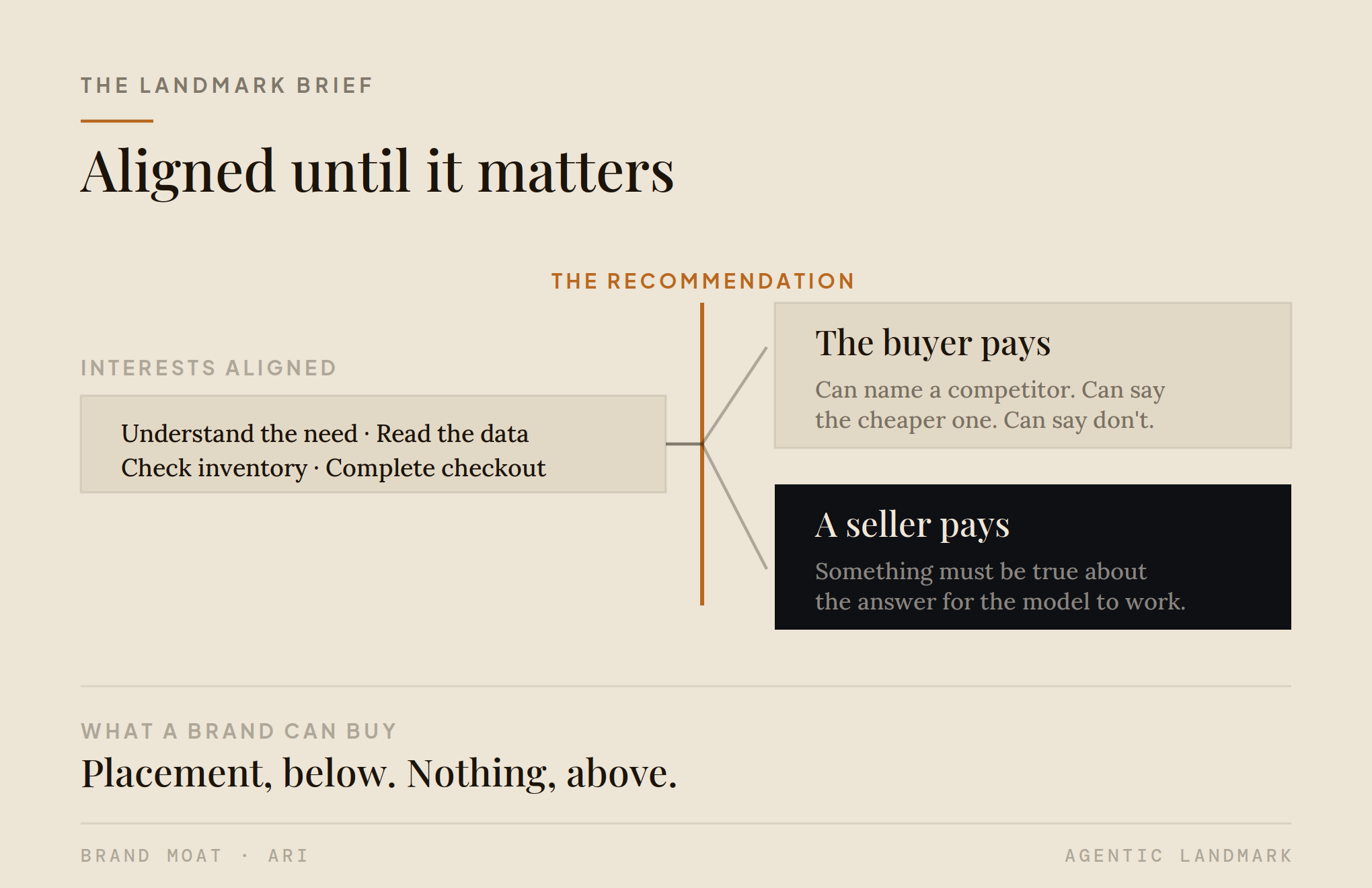
The most useful agents will be the ones brands have the least commercial leverage over, and that is a structural fact about who pays rather than a policy anyone chose.
Earlier in this series I argued that the merchant of record and the merchant of decision have come apart, and that the merchant of decision is whoever built the agent, set its evaluation criteria, and owns the surface where the buyer's intent gets formed. That piece stopped where the unbundling was established.
The question it leaves open is the one a CMO asks next, and it is a practical one. If someone else is now making the decision, how do I get into it? Who do I call, and what does it cost?
For the agents that will matter most, there is nobody to call. Not because the market is immature and a rate card is coming, but because of what an agent has to be in order to be worth delegating to in the first place.
The divergence is at one specific moment
An agent and a seller want the same thing for most of a transaction. Both want the need understood correctly. Both want accurate product data, real inventory, a checkout that completes. Through all of that, the interests are aligned, which is why so much agentic commerce infrastructure work is uncontroversial and why every party is happy to build it.
There is exactly one moment where the interests come apart, and it is the moment that decides the sale. When the agent narrows to a recommendation, the buyer wants the best fit. A seller wants its own product. If the seller is paying for the agent, that preference has somewhere to enter.
Everything about the structure of the market right now is a consequence of that single divergence point.
What a buyer's agent has to be able to do
The test is not what an agent says about its independence. It is what it is permitted to do at the divergence point.
A buyer's agent has to be able to recommend a competitor when the competitor fits better. It has to be able to say that nothing in the category is worth the money right now, or that the cheaper option is sufficient, or that the thing the buyer already owns does not need replacing. Each of those is a recommendation that costs someone a sale, and a buyer's agent has to be able to make it without anything in its economics arguing back.
That is a demanding standard, and it is why the question of who funds the agent is not a detail. An agent funded by the buyer can meet it. An agent funded by placement cannot, whatever its intentions, because the constraint is not honesty but incentive.
Buyers can detect this without analyzing it
The counter is that consumers never scrutinized search results this closely, and search monetized through paid placement perfectly well for two decades.
The difference is what is being delegated. A search result is a list to evaluate; the human still chooses, and a sponsored listing among ten is visible and discountable. A recommendation is the choice, and increasingly the whole consideration set. When one option is returned instead of ten, sponsorship is not a labelled row anymore. It is the answer.
Buyers do not need to reason this through to respond to it. What they experience is whether the recommendations turn out well over time, and delegation extends or retracts accordingly. An agent that quietly optimizes for margin produces a worse hit rate, and the buyer notices the outcome without ever diagnosing the cause. The mechanism is invisible. The consequence is not.
The pressure runs the other way, hard
None of this means buyer-aligned agents automatically win. The economics point the other direction, and it is worth being clear-eyed about that.
Charging buyers directly is the cleanest alignment and the hardest sell, because consumers have thirty years of training that this category is free. Commission on completed transactions looks neutral and is not quite, since it rewards the agent for a purchase happening at all and, depending on structure, for a more expensive one. Seller-funded placement is the most proven monetization model on the internet and the one every incumbent already knows how to operate.
So the pressure toward placement is enormous, and it will not be resisted everywhere. What is likely is a market that separates: agents that took placement money and are consequently used for lower-stakes, lower-consideration purchases, and agents that did not and are trusted with the decisions that matter. Both survive. They are not competing for the same delegation.
What this means if you are the brand
The strategic consequence inverts a relationship most marketing organizations are built around.
In every prior channel, sufficient budget bought presence. Search, social, retail media, all of it had a rate card. In the agents that earn the highest-value delegation, there is no rate card by design, and building one would destroy the thing that made them valuable.
That leaves an uncomfortable but clarifying position. Your commercial leverage is lowest exactly where the delegation is highest. The agents you can pay are the ones handling purchases the buyer did not care much about. The agents handling the decisions you most want to influence are the ones where money does not enter.
The practical implication is that budget stops being the lever and evidence becomes it. Whether your claims are specific enough to be checked, whether your data says the same thing everywhere, whether the thing arrives as described often enough to show up in the aggregate. This series has covered the mechanics of both, and the point here is narrower: those are not merely the best available tactics while the channel matures. In the highest-value part of the channel, they are the only inputs, permanently, because the alternative input has been designed out.
The question to ask about any agent
There is a single diagnostic that cuts through most of the positioning, and it is worth asking of every agent surface a brand is evaluating.
Who pays, and what happens at the moment of recommendation?
If the buyer pays, the agent can afford to tell them not to buy. If a seller pays, something has to be true about the recommendation for the business to work, and whatever that something is, it is operating whether or not anyone intended it to.
Brands should ask this about the agents they are trying to appear in, because it tells them what kind of appearing is even possible. And it is worth noticing that a company can be genuinely committed to buyer alignment and still be structurally unable to sustain it, if the money it took requires otherwise. Intent is not the variable. The funding is.