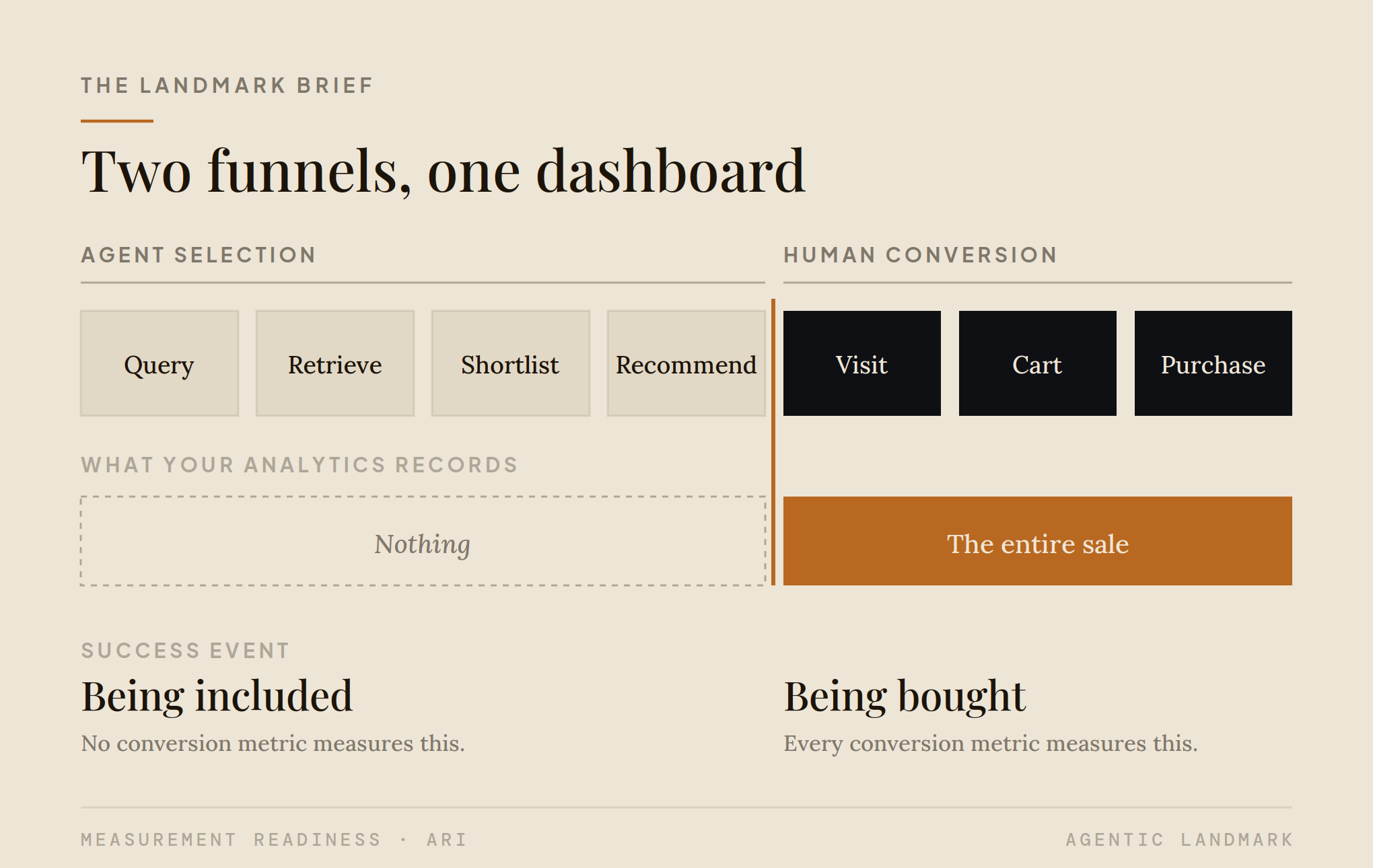
Agent selection is a funnel with its own stages, its own failure modes, and its own success event, and almost nobody instruments it.
Earlier in this series I argued that the best-converting channel most brands have is the one their analytics are trained to ignore, and named what to build: server-side classification, an attribution model that credits agent-influenced discovery separately, and a price-at-time-of-selection baseline for catalogs where price moves.
Most teams read that list, recognized a data engineering project, and did nothing. This is the version you can start without one.
The funnel nobody instruments
The reason credit goes missing is structural, and it is not really an analytics failure. There are two funnels running, and every analytics package in common use was designed around the second one.
Upstream is agent selection. A query arrives somewhere you do not control. The agent retrieves candidates, narrows to a shortlist, and recommends. The commercial event, the moment you are compared against three competitors and either included or dropped, happens entirely inside that sequence.
Downstream is human conversion. Visit, cart, purchase. This is the funnel with the dashboards.
The two are not stages of one process. They have different actors, different failure modes, and different success events. Downstream success is a sale. Upstream success is being included at all, and no conversion metric measures inclusion.
Winning one and losing the other looks identical in your numbers
This is why blending them is expensive rather than merely imprecise.
A brand can be strong upstream and weak downstream. Agents recommend it constantly, and the buyers arrive and do not convert, because price moved, or stock was thin, or checkout could not be completed programmatically. The dashboard shows soft conversion and suggests a landing page test.
A brand can be weak upstream and strong downstream. It converts beautifully on the shrinking population of buyers who still arrive without an agent, and is quietly absent from the consideration sets forming elsewhere. The dashboard shows healthy conversion right up until volume falls off a cliff, and by then the upstream position took a year to erode and will take longer to rebuild.
Both cases produce an unremarkable blended number. Neither is diagnosable from it. The single funnel view does not just under-report the agent channel, it produces confident recommendations aimed at the wrong half of the problem.
Three layers you can build before the engineering
Server-side classification is the right foundation and it is a quarter of work with a dependency on your platform team. These three layers do not wait on it, and together they are enough to defend a budget.
Visibility tracking, as a leading indicator. Whether agents surface you at all, on which prompts, against which competitors, and how that moves. This is upstream instrumentation, the only kind available today, and it is not revenue. That is the point. It moves before revenue does, which makes it the earliest signal you can act on and the one most worth standing up first.
Self-reported attribution, as directional truth. Add an AI assistant option to the how-did-you-hear-about-us field on lead and order forms. It undercounts, respondents misremember, and it is the fastest honest signal most brands can have running inside a week. A number that is directionally right and admits its error bars beats a precise number that is silently wrong.
Correlation analysis, as the argument. Track visibility movement against pipeline and revenue over several quarters. Correlation is not causation, and a consistent directional relationship sustained across quarters is evidence, which is strictly more than the channel has now.
Note what each layer is for. The first tells you something changed. The second tells you roughly how much. The third is what you say out loud in the room where budget gets allocated. They are not three attempts at the same measurement, they are three different jobs, and a brand that builds only the first has a signal it cannot spend.
What good enough actually means
Good enough is not a weaker version of deterministic attribution. It is a different standard, and it is the one the situation supports.
Deterministic attribution answers which touch caused this sale. No layer above answers that, and no protocol available today answers it either. What the layers answer is whether the agent channel is growing, roughly what it is worth, and whether the work you are doing on it is landing. That is sufficient to fund a channel, staff it, and set a target against it.
It is worth being explicit about the failure mode on the other side. A brand that insists on precision before it will act does not get precision. It gets another four quarters of the channel reading as unproven in numbers it already knows are wrong, which is the loop the earlier piece described, running with the brand's informed consent rather than in spite of it.
The part that does not wait
There is one asymmetry worth sitting with.
When a measurement standard for agent-influenced discovery does arrive, and something will eventually, it will apply forward. It will not reach back and reconstruct which of last year's direct-channel revenue an agent actually sourced. Standards do not come with history attached.
So the brands that stood up crude layers now will have two years of movement to read the standard against, and a baseline that makes the first proper numbers interpretable. The brands that waited will have the standard, an accurate reading of one quarter, and nothing to compare it to.
The detection work, the moving-baseline problem, and why Measurement Readiness sits outside the ARI composite rather than inside it are all in the earlier piece. This one is about the funnel that piece did not name. You are paying for both. Instrument both.