An org chart records who answers to whom, which is not the same question as what may be committed, and agent software is now shipping the former as though it were the second.
The chart came back
Earlier in this series I worked through the argument that corporate hierarchy was always an information routing protocol, built around the limit on how many people one person can coordinate, and that AI removes the constraint that made it necessary. I still think that reading is right about the history.
What I did not expect was how fast the chart would come back, pointed at machines.
A category of product now ships the org chart as the interface for running agents. You define roles. Roles carry standing instructions. Roles sit in reporting lines. A manager agent decomposes a goal and assigns the pieces to worker agents, and anything exceeding an agent's pay grade escalates upward. It is an intuitive model. Every operator already knows how to read it, which is most of why it works as an interface.
It is also the wrong unit of analysis for the one thing that decides whether an agent program survives contact with production.
A reporting line is not an authorization boundary
An org chart encodes who reports to whom. Agent safety is decided by what may be committed, on which workflow, by which principal. Those two things are not the same object, and they do not map onto each other.
A manager agent and a worker agent have a reporting line. They have no authorization boundary between them. Nothing about the manager sitting above the worker in a diagram constrains what the worker is able to commit when it runs. The line is a coordination artifact. The boundary is a control, and it has to be written somewhere else.
This is the distinction the Operational Agent Readiness Index scores under Authorization Maturity, which is the heaviest of its five dimensions. Authority is assessed per workflow, at three boundaries: what an agent may execute on its own, what requires human approval, and what has to escalate. An org chart is per role by construction. It cannot express a per-workflow boundary, because a role is not a workflow. The same role touches a dozen workflows with wildly different stakes, and a chart flattens all of them into one line.
The consequence is specific, and it is worse than having no chart. An organization that has drawn its agent org chart has produced the artifact that feels like governance. It looks complete. It hangs on a wall. And it will answer the authorization diagnostic poorly while believing the opposite, which is a harder position to correct than not having started.
The question that separates the two
Underneath this sits a choice every operating model makes, usually without anyone noticing it was a choice.
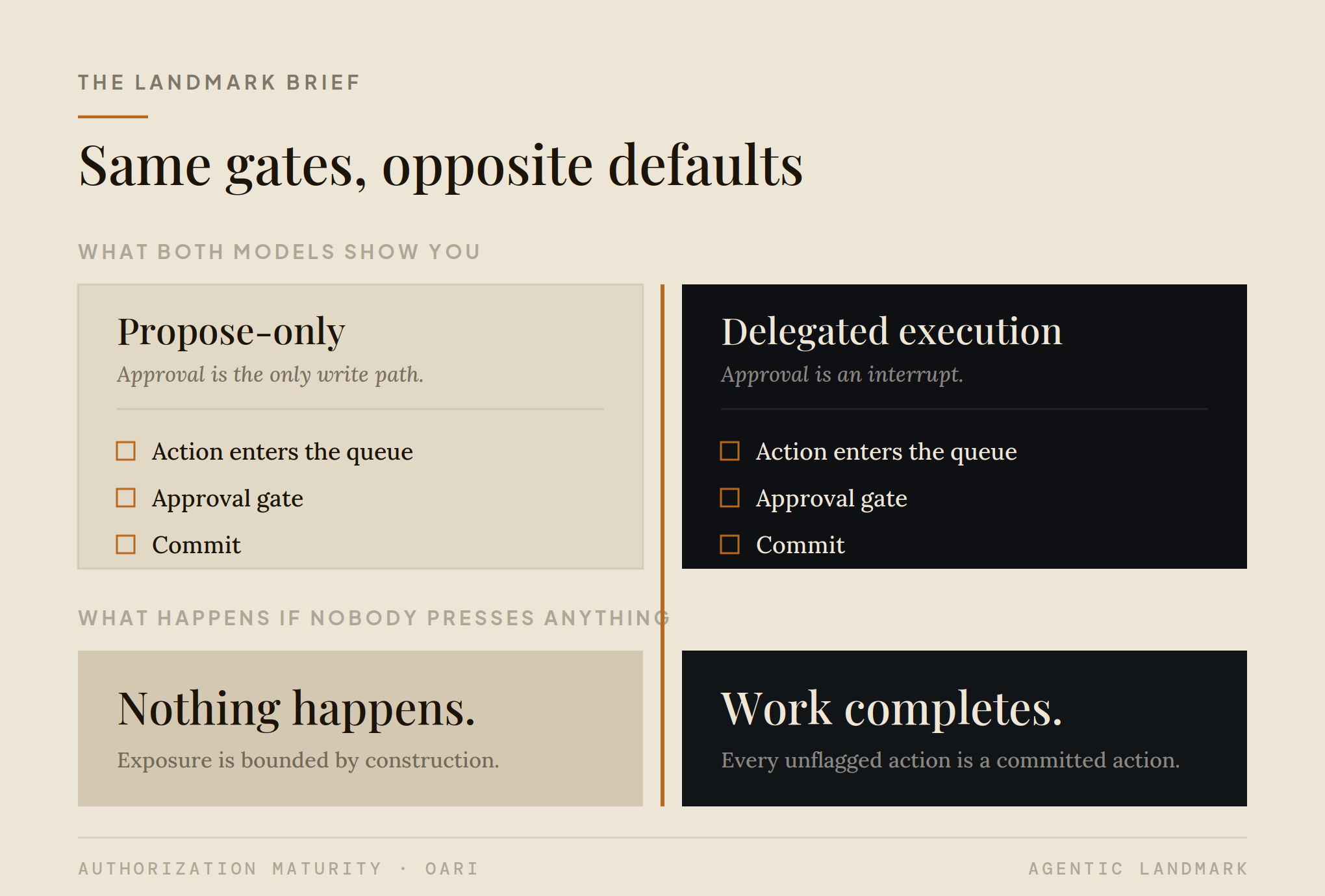
Delegated execution. The resting state is that work completes. Agents act, and human approval is an interrupt inserted on the actions someone flagged as sensitive.
Propose-only. The resting state is that nothing happens. Agents produce proposals, and human approval is the only path to a write.
Both models have approval gates. Both can show you an approvals queue. A feature comparison puts them in the same row. They are opposites, and the difference is not the gates; it is what happens in their absence.
So the test is one question: if nobody presses anything, what happens?
If the answer is that work proceeds, you are running delegated execution, and every unflagged action is a committed action. If the answer is that nothing happens, you are propose-only, and your exposure is bounded by construction whatever your policies say.
Neither answer is wrong. They carry different risks, and they need different controls. What is expensive is not knowing which one you picked, and an org chart interface will not tell you, because both models draw the same chart.
The map you still cannot produce
There is a cheaper version of the same diagnosis, and it takes about a minute.
Could you produce today, without investigation, a map of every agent you have deployed, every workflow it acts on, the permissions it holds on each, and the named human accountable for it?
Most organizations cannot. The ones that have drawn an agent org chart usually cannot either, which is the point. They have an artifact, and it is not that artifact. It answers who, and the question is what, on which workflow, revocable by whom, and how fast.
If assembling that map would take a week of investigation, that is not a documentation gap. It means the authority is not expressed anywhere that can be enforced, only inferred from configuration scattered across systems that were never designed to describe an agent.
What happens when an agent assigns work to an agent
The org chart interface introduces one structural feature that almost nobody prices, and it follows directly from the manager-agent pattern.
When a manager agent assigns to a worker agent, the delegation chain extends. The question is whether authority inherits correctly across that call. Does the worker act within the bounds the manager holds, or does it act with its own standing permissions, which may be broader? Can privilege escalate silently across a hop that no human reviewed?
The chart makes that chain look like an accountability structure. It is an authorization surface, and it is the one most likely to be unbounded, because it was drawn to describe delegation between colleagues, where the constraint was social rather than technical.
Keep the chart, draw the second artifact
None of this is an argument that the software is bad. These tools do a real job; they do it well, and most teams that bought one bought sensibly. Task decomposition needs a coordination model, and a chart humans can read at a glance is a good one. Keep it.
The correction is that the chart is not the whole picture, and the missing half is the half that bounds the damage. Next to the chart, draw the artifact it cannot produce: per workflow, the three boundaries, the named human, and how fast authority can be tightened when something goes wrong. That second artifact is the one that answers the question a board asks after an incident.
Earlier in this series, I argued that being cited by an AI system is not the same as being usable by one, because a surface that resembles readiness is not readiness. This is the operational version of the same error, one door over. A reporting line resembles a control. It is not one.
The org chart tells you who to ask. It does not tell you what already happened without asking.