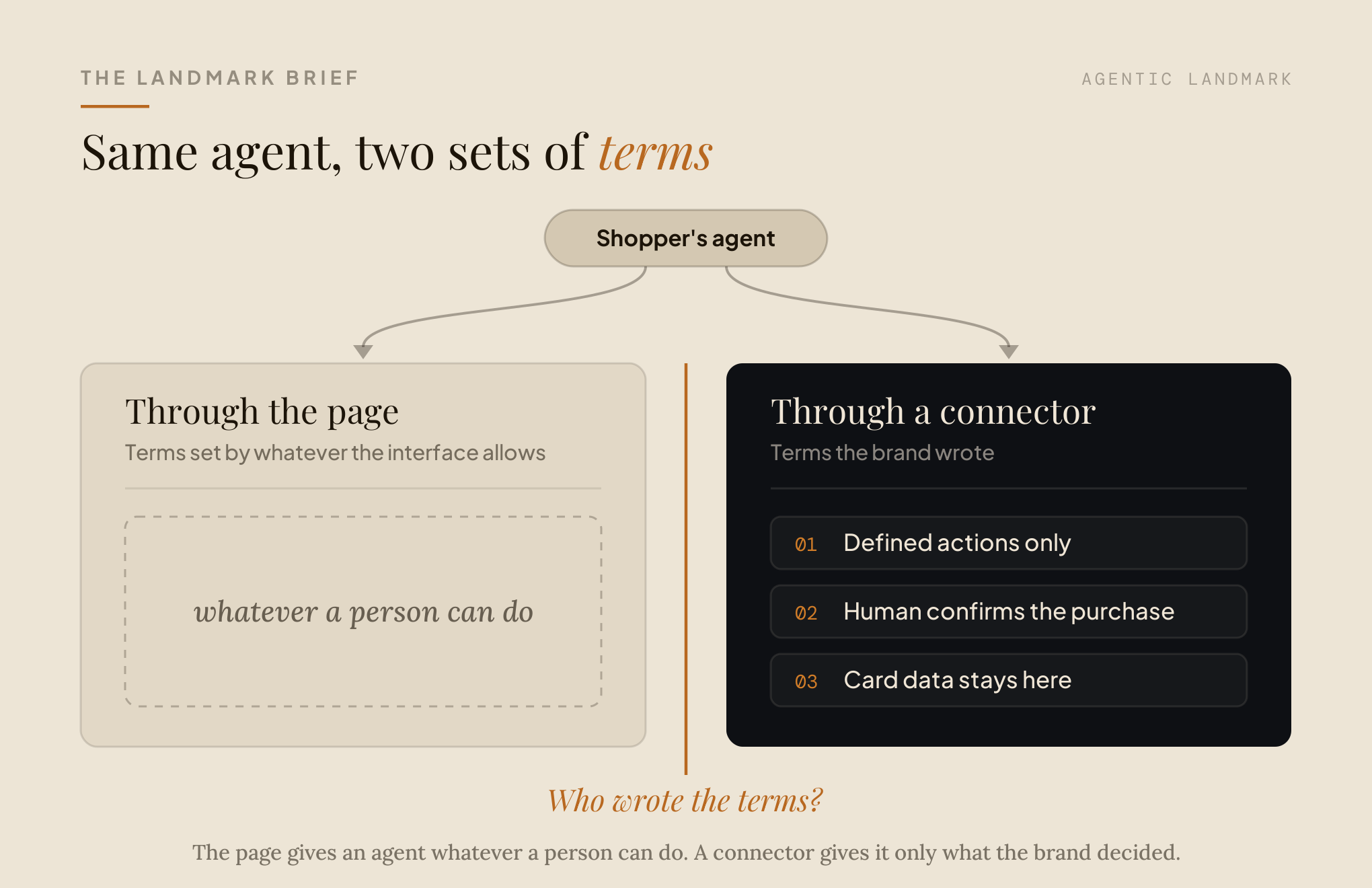
When an agent can use the page a human uses, the page is the only rule the brand wrote.
In 2001, Tim Berners-Lee described a web that software agents would navigate on our behalf. It never arrived, because it asked every site owner to tag every page so a machine could tell an address from a list of services. Nobody did the labor, and the people who would have had to do it could not see the benefit.
This week MIT Technology Review argues that large language models removed the tagging requirement and that the agentic web arrived anyway. The piece describes two ways to build it. Agents can use the human web the way we do, scrolling, clicking, and typing in a browser. Or they can reach a site through text and code: the connectors, plug-ins and tool interfaces a brand designs for them. Until recently, the first route looked like the fallback. Computer-use agents have improved fast enough that Ethan Mollick, quoted in the piece, says "the AI agents just were able to cross the bridge already."
This series has been on the other side of that bet. Being cited is not being usable put WebMCP at the interactive end of the stack and treated an agent working the screen as the brittle path a declared interface would replace. The reporting says the brittle path is now good enough. That changes less about whether agents can reach a brand than about who sets the terms when they do.
What the browser route takes away
The two routes do not differ mainly in reliability. They differ in who writes the rules.
A connector is a set of decisions. Someone at the brand chose which actions an agent may call, which fields it may read, and where a human has to step in. The article's own example makes the point: when Meta's Muse agent buys through Stripe's Link, the payment service holds the card number, the agent never sees it, and a person confirms the purchase before it goes through. That is not a convenience feature. It is an authorization boundary that someone designed.
A browser agent arrives with none of that. It gets what the page gives a human: every button, every form, every price, every account screen the customer can reach. The article puts the consequence plainly. Whatever a site makes available to people is available to agents too, and the only alternative is to block agents outright, which carries its own cost.
So the page becomes the policy by default. Nobody designed it as one. A product page was built to persuade a person, a checkout was built to be fast for a person, and an account area was built on the assumption that the person in it is the person who signed in. None of those surfaces was asked what an agent acting for that person should be allowed to do. When the agent can operate them anyway, the answer is: whatever the person could.
The practice has argued that agent readiness has two layers in a fixed order, discovery and then infrastructure. The browser route does not remove the infrastructure layer. It removes the brand's chance to decide what that layer permits.
Walmart wrote the terms down
On October 21, Walmart did the thing the browser route skips. It published terms for AI agents alongside an MCP-based Agent Gateway and Agent Profiles inside customer accounts.
Read as a document, the terms answer the questions a page never asks:
- Who approves. Customers can require approval for every purchase or let the agent buy within a spending limit they set, and Walmart may require additional approval even within that limit.
- What the agent may see. Agents do not receive payment card information and cannot add or change payment methods. They get only the information the task needs, and the customer allows.
- How far it may go. Agents must not take actions beyond what the shopper intends.
- What happens if it breaks the rules. Agents who do not follow the terms are blocked from Walmart's site.
- Who stays in control. The customer does, and Walmart's returns process applies.
The qualifier matters, and it belongs in any sentence about this. Only the rulebook is live. Walmart's own gateway page calls the gateway an early beta, available by invitation only, that may be suspended at any time. Agent Profiles were announced as launching within a month. Walmart has not opened its store to agents. It has written down the conditions under which it will.
That still matters, because it treats agent access as a set of conditions rather than a yes or no. It is also no longer alone. Home Depot's CIO has since said the retailer will support shopping agents that identify themselves as agents and confirm the customer they represent, as reported by PYMNTS, citing Business Insider.
Three postures, one question
Set the autumn's decisions side by side and three postures appear.
| Posture | Example | What the agent gets | Who wrote the terms |
|---|---|---|---|
| Open by default | Shopify's Agentic Storefronts | Catalog fields and checkout, switched on | The platform, for every merchant on it |
| Closed | Amazon's block on Muse | Nothing, enforced through terms of use | The platform, by refusal |
| Conditional | Walmart's agent terms | Defined actions, under stated conditions | The retailer, in writing |
Neither platform asked the brand to read the first two, as one decision pointed in opposite directions, made by the platform on behalf of every brand beneath it. The browser route adds a fourth row that nobody chose: the brand's own site, open to any agent that can operate it, on terms set by whatever the page happens to allow.
That fourth row is where most brands sit today. It is not a strategy. It is the absence of one that a capable enough agent can walk straight through.
It also cuts both ways. The same surface that admits a shopper's agent admits a competitor's agent harvesting prices, assortment, and stock levels. A page cannot tell them apart, and it was never asked to. Access design is a governance question before it is a technical one.
What to write before an agent arrives
The article closes on open questions about whether the human web survives. Those are worth asking. The brand's question is narrower and more urgent: if a capable agent is already operating your site for a customer, what did you decide it may do?
Walmart's terms are a usable template for the answer, whatever a brand thinks of Walmart's commercial motives. Five questions, each one a decision someone should own:
- Which actions may an agent take, and which stay human only? Browsing and comparing are one thing. Placing an order, changing an address or cancelling a subscription are another.
- Does the agent have to say what it is? If it does not identify itself, nothing downstream can treat it differently, including your analytics.
- Who confirms, and at what threshold? A spending limit, a confirmation step, a category that always needs a person.
- What may the agent see? Payment data, order history, and saved details are the obvious lines.
- What happens when it acts beyond intent? Returns, reversals, and who carries the cost, written down before the first dispute rather than after it.
A brand can answer these without building anything yet. The answers are what a connector, a WebMCP tool contract, or a set of terms would later enforce. Without them, the build has nothing to enforce, and the browser agent has no reason to wait for it.
The agentic web did not need the semantic tags Berners-Lee asked for. It still needs the terms. A connector is where a brand writes them. Without one, the page writes them for it.