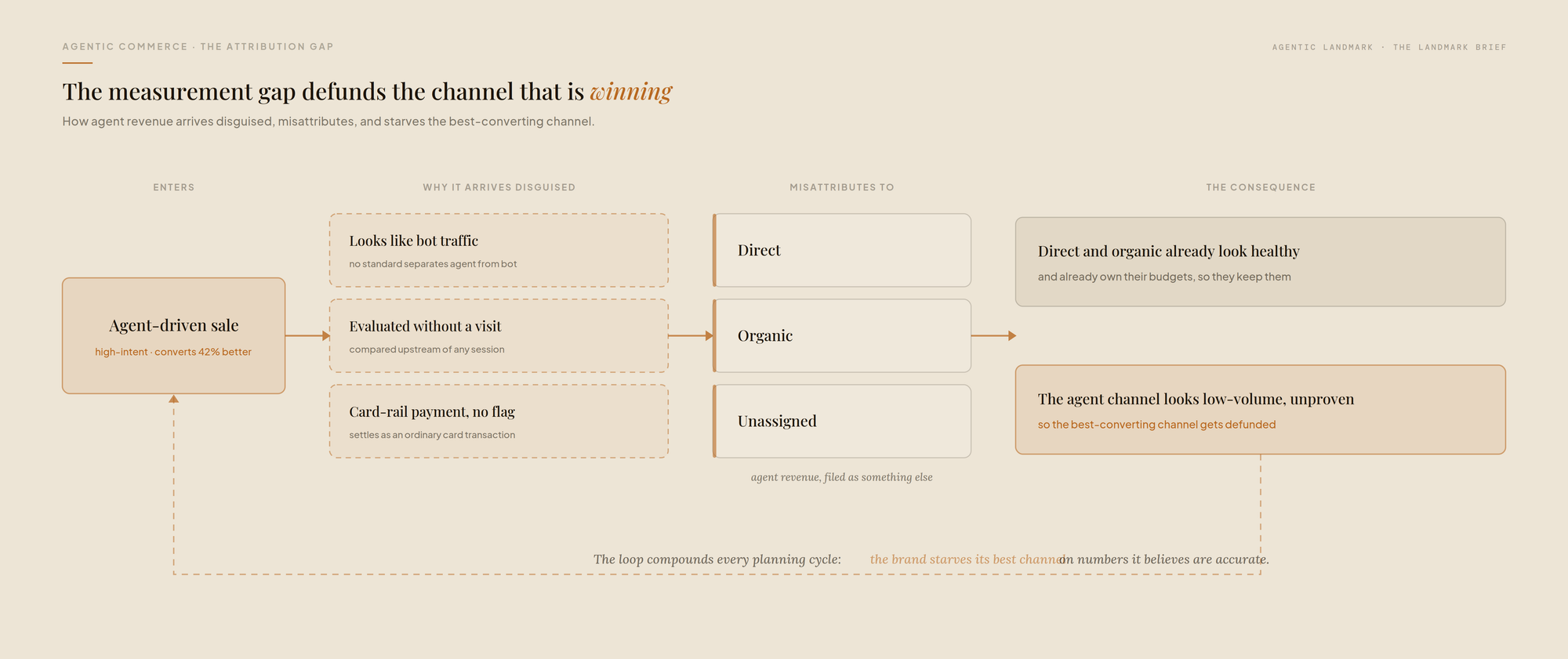
The measurement gap in agent-mediated commerce is not a reporting problem. It is a budgeting problem, and it defunds the channel that is already winning.
The channel is converting. The analytics are not reporting it.
In March 2026, AI-sourced traffic to US retail sites converted 42% better than non-AI traffic. Twelve months earlier, it converted 38% worse. That is roughly an 80-point swing in a single year, recorded alongside AI traffic to US retail sites growing 393% year over year in Q1 (Adobe Q2 2026 AI Traffic Report). The channel is no longer exploratory. It is high-intent, high-conversion commercial traffic.
Now open your analytics and try to find it.
For most brands, the number is not there. Not because the traffic is not arriving, but because the stack cannot see it for what it is. Agent-driven revenue lands in the same buckets it always has: direct, organic, unassigned. The brand is capturing the best-converting channel in its funnel and filing the proceeds under a label that tells the CMO nothing.
Why agent revenue arrives disguised
There are three separate mechanisms, and it is worth naming each precisely.
First, agent traffic is currently indistinguishable from bot traffic in most analytics stacks, and no cross-platform standard exists to separate them. An agent evaluating a product looks, to a conventional analytics tool, like something to filter out.
Second, the agent frequently evaluates without visiting at all. Botify's crawl data shows roughly one human visit per 198 OpenAI crawls, against one visit per six Google crawls. The commercial event, the moment the brand is compared and shortlisted, happens upstream of any session your tools were built to record.
Third, and most concretely, the payment layer now hides the transaction itself. Buyer-side agent payment credentials such as Skyfire and Visa Intelligent Commerce issue a spending instrument to the agent and settle through ordinary card rails. The brand receives a standard card transaction with no protocol flag. A brand can be fully UCP-compliant, meaning its checkout is exposed to agents through the Universal Commerce Protocol, and still take agent-initiated card purchases it cannot distinguish from a person typing in a card number. Without server-side signal detection, those purchases misattribute to direct or organic by default.
Two failures hiding inside one number
The phrase "attribution gap" actually contains two distinct failures, and they require different fixes.
The first is agent traffic measurement: can you see the visit at all, and classify it correctly? This is a detection problem, solved with server-side signal work.
The second is agent-influenced attribution: can you credit the agent recommendation that preceded a human purchase? There is no protocol-level standard for this today. When an agent surfaces your brand in a consideration set, and the consumer later completes the purchase themselves, the recommendation did the selling and the last click takes the credit. This is the discovery versus selection problem made financial. The agent handled discovery. Your attribution model only knows how to reward the surface where selection was recorded.
Recommend and transact are not the same event, and they are increasingly not measured by the same system.
The moving baseline
Even brands that solve detection hit a methodology problem underneath. Conventional conversion measurement A/B tests against a control group holding a stable price. Agent-mediated selection breaks that assumption. The agent performs real-time comparison at evaluation time, so the price at the moment of the agent's query is what determines selection, not the average price across a test window.
For any brand running dynamic pricing, the human-channel attribution model is now measuring against the wrong baseline. The agent channel needs a separate model that accounts for price at time of selection rather than price at time of click. Otherwise, the brand is grading that channel on a test it was never actually running.
The blind spot is self-reinforcing
Here is why this is not a back-office reporting nuisance but a strategic exposure.
Misattributed agent revenue does not disappear. It gets reassigned to direct and organic channels that already look healthy and already own their budgets. The agent channel, meanwhile, shows up in the dashboard as low volume and unproven ROI, because most of what it produced was credited to something else. So it gets underfunded. The brand starves the exact channel converting 42% better than everything else, and it does so on the strength of numbers it believes are accurate.
That is the trap. The measurement gap does not just hide performance. It actively redirects investment away from the winning channel and toward the channels quietly absorbing the winner's credit. Left alone, it compounds every planning cycle.
This is why the practice treats Measurement Readiness as a qualifying dimension, independent of the five scored ARI dimensions. Traffic Dependency, Structured Comparability, Agent Substitutability, Brand Moat, and Structured Data Maturity tell a brand how exposed it is. Measurement Readiness asks the prior question: would you even be able to see that exposure playing out in your own numbers? A brand can score well on catalog structure and still be blind on channel performance, which means it cannot manage the transition it is already inside of.
What this asks of the CMO
The remediation is not exotic. It is server-side agent traffic classification, an attribution model that credits agent-influenced discovery separately from last-click selection, and, for dynamically priced catalogs, a baseline that measures price at time of selection. None of it requires waiting for a standard to settle. The brands that build measurement infrastructure now will be able to defend the agent channel's budget with evidence. The brands that wait will keep defunding their best channel with confidence.
You cannot optimize a channel you cannot see. And right now, the best-converting channel most brands have is the one their own analytics are trained to ignore.