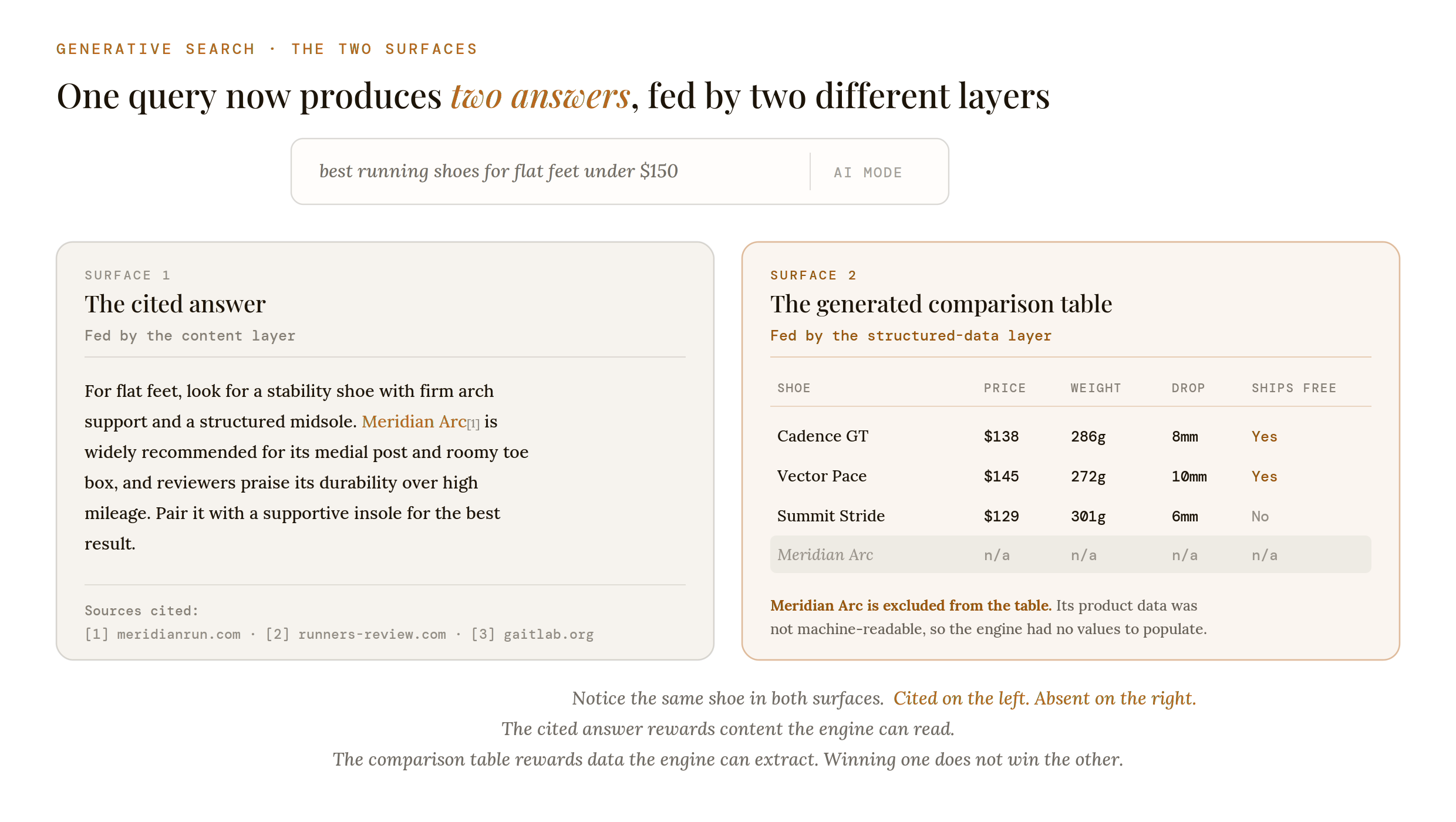
At Google I/O 2026, Search stopped returning links and started assembling interfaces. That one change quietly rewrites what a decade of search optimization was actually for.
The most consequential thing Google announced at I/O was not the billion users. It was a feature most of the coverage skipped, because it does not look like a commerce story or a consumer story. It is a search story, and it changes the job of everyone who optimizes for search.
The headlines went where you would expect. AI Mode crossed one billion monthly users. The Universal Cart assembles a shopper's selections across merchants. New agents book restaurants and place phone calls on a consumer's behalf. Each of these is real, and each deserves attention.
But underneath them sat a quieter announcement called generative UI. In response to a single query, Search can now build a custom interface on the fly. Not ten blue links. Not even a cited paragraph of generated text. An actual comparison table, an interactive calculator, a visual tool, a simulation, a persistent dashboard, Google calls a mini app, assembled in real time for that one specific question.
Read that again with your own work in mind, because if any part of your job involves making a brand visible in search, the ground just moved.
What optimization is rewarded, and what it rewards now
For roughly a decade, search optimization has rewarded content that the engine could read and cite. You wrote authoritative, well-structured, statistic-rich prose. You earned a ranking and later a citation in an AI Overview or a Perplexity answer. The lever was content quality. Generative Engine Optimization, the discipline that grew up around AI search, refined that lever for a generative world, but it did not change the underlying premise. The premise was always: write the thing well enough that the engine chooses to surface it.
Generative UI rewards something different, and the difference is not a refinement. It is a category change.
When the engine assembles a comparison table, it does not lift sentences from your buying guide. It populates cells. It needs a value for price, a value for material, a value for warranty length, and a boolean for whether the thing ships free. It pulls those values from structured, machine-readable data, not from the paragraph where you described them beautifully. Your prose can be the best on the internet, and your brand can still be absent from the table, because the table is not made of prose. It is made of fields that the engine can parse, compare, and render.
You can write the best buying guide on the internet and still be missing from the comparison table the engine builds. The table is not made of prose. It is made of data.
This is the part worth sitting with. A brand can do everything GEO has asked of it for the last three years, win the citation, appear in the answer, get named as a source, and still not appear in the interactive tool the engine generates to actually help the user decide. The citation and the tool are now two different surfaces, drawing from two different layers of the brand's presence.
The shift, stated plainly
GEO is moving from citation-worthiness to structured-data-worthiness. From a content-marketing problem to a data-architecture problem.
That sentence is short on purpose because it is the whole argument. The work of being found used to live in the editorial function: writers, content strategists, and the people who know how to make a page authoritative. The work of being usable now lives partly in the data function: the product information management system, the schema, the feed, and the people who know how to make a fact machine-readable. Generative UI does not replace the first kind of work. It adds the second kind as a hard requirement, and it puts the two on the same critical path.
Adobe's Q2 2026 AI Traffic Report found that the average US retail product page is 66% machine-readable to large language models. The best-performing sites reach 82.5%. The lowest sits at 54.2%. The gap between a brand that shows up in the generated tool and one that does not is largely the gap between those numbers.
The Adobe benchmark matters here because it quantifies how unprepared most brands are for exactly this shift. A product page that is two-thirds machine-readable was good enough when the engine only needed to cite the page. It is not good enough when the engine needs to extract structured values to build a comparison that the user sees instead of the page.
Why is this uncomfortable for how teams are built?
In most organizations, the content team and the structured-data team are different functions. Often, different budgets. Sometimes, different departments meet twice a year and otherwise leave each other alone. Content reports to marketing. Product data reports to e-commerce operations or merchandising or, in the worst cases, to nobody in particular and lives in a spreadsheet someone updates when they remember.
Generative UI collapses that separation, and it does so without asking permission. The brand that appears in the generated comparison is the one whose content and structured data are a single, coordinated investment. The brand that keeps treating them as two sequential projects, content this quarter, data architecture maybe next year, will keep earning citations while quietly disappearing from the tools those citations were supposed to lead to.
There is a version of this problem that is even more specific. Google built generative UI on Gemini 3.5 Flash and its Antigravity development platform, which means the interfaces are generated by a coding agent in real time. The engine is not selecting a pre-built template and slotting your data in. It involves reasoning about what interface the question deserves and constructing it. The brands whose data is clean, complete, and consistently structured are the raw material that agents reach for. The brands whose data is partial or inconsistent are simply harder to build with, and an agent optimizing for a good answer will route around difficulty the same way water routes around a rock.
What this does and does not change
It does not make content worthless. Authority, accuracy, and citation-worthiness still determine whether the engine trusts a brand as a source, and trust is upstream of everything. A brand with no credible content presence will not be pulled into a generated tool, no matter how clean its feed is, because the engine has no reason to believe its numbers. Content earns the right to be considered. That has not changed.
What changed is that content is no longer sufficient. The brands that win the generated interface are the ones that pair editorial authority with structured-data discipline, and treat the two as one capability rather than two departments. The discipline formerly known as GEO is converging, in real time, with the structured-data work that agentic commerce has required all along. I/O did not invent that convergence. It made it visible, and it put a one-billion-user surface behind it.
For a decade, the question was whether your content was good enough to be cited. The new question is whether your data is clean enough to be built with.