They sound similar. They describe fundamentally different things. One makes your platform smarter. The other makes it addressable.
The term "AI native" has become the default label for any digital platform that has embedded generative AI into its core experience. The AI helps users draft content, summarize data, flag anomalies, and make decisions faster. This is genuinely useful. It is also not what the next three years require.
There is a second category that most organizations have not named clearly: agent native. And the failure to distinguish between the two is producing a generation of platforms that will be smart and useless at exactly the wrong moment.
What AI Native actually means
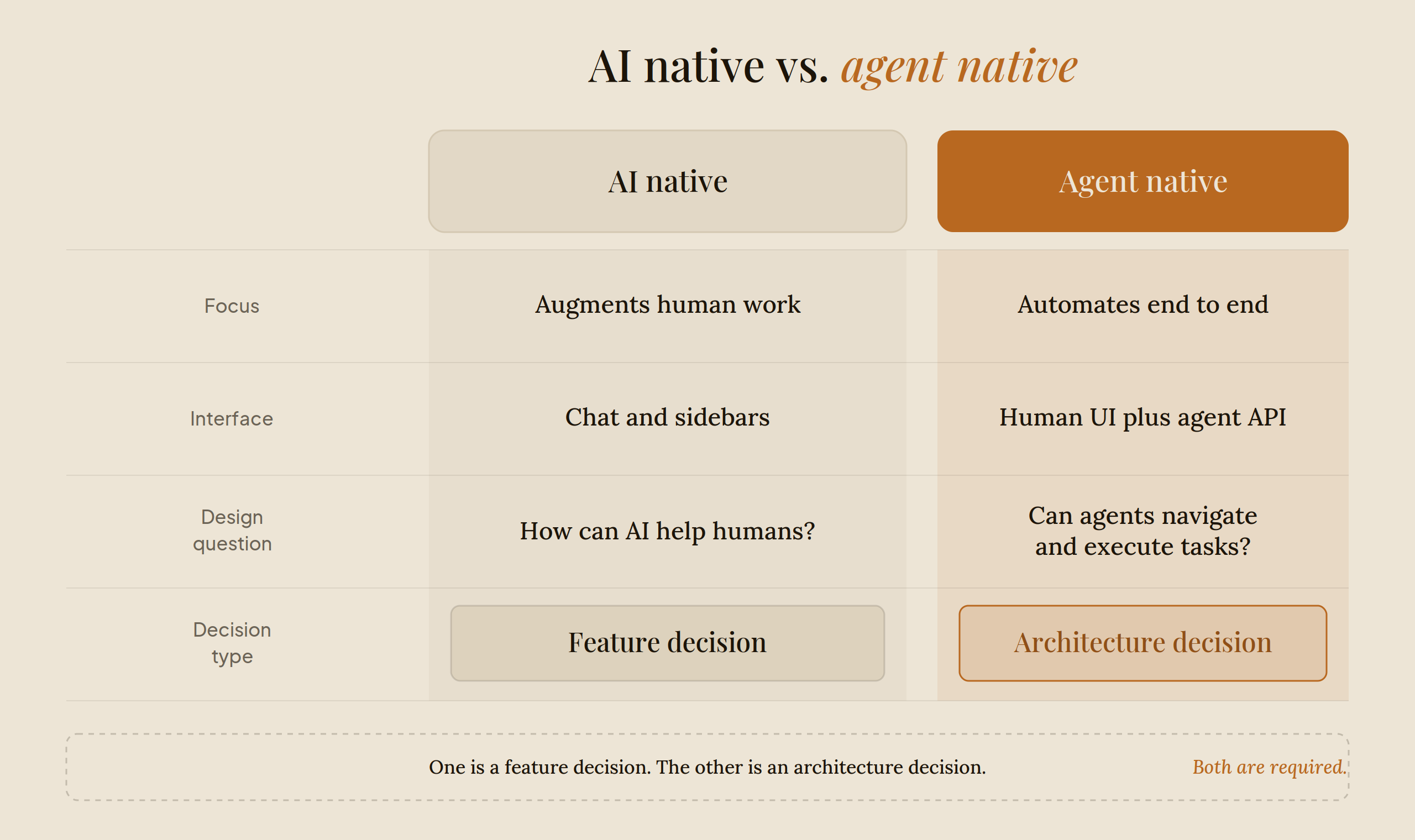
An AI native platform is one where artificial intelligence augments human work. The AI generates, summarizes, assists, and recommends. The human reviews, decides, and acts. The interface is designed for human perception: chat sidebars, conversational prompts, highlighted suggestions, and confidence scores displayed in dashboards that humans read.
The design paradigm is: how can AI help humans do tasks faster and better?
This is a feature decision. You are adding capability to an existing system whose fundamental architecture, screens, buttons, and human-initiated workflows were designed for human users. The AI layer sits on top of that architecture and improves it. The architecture itself does not change.
Most enterprise software platforms are AI native today, or claim to be. They have added AI features. Their underlying architecture remains human-first.
What Agent Native actually means
An agent native platform is one designed from the start or redesigned from the core to be addressable by autonomous agents operating on behalf of humans.
The design paradigm shifts entirely: how do we build systems that autonomous agents can navigate, plan, and execute tasks within?
This is an architecture decision. It requires that every capability in the platform has an API surface, a named permission structure, and event emission. Not so that AI can help a human use the capability. So that an agent can call the capability directly, with delegated authority, without a human navigating the interface at all.
The interface implication is specific: an agent native platform has a dual interface. There is a human UI, screens, buttons, and visual workflows for the humans who still use the system directly. And there is an agent API layer, tools, protocols, and structured data endpoints that expose the exact same system capabilities to agents operating autonomously. Not a separate system. The same system is accessible two ways.
An AI native platform asks: what AI features should we add to help our users?
An agent native platform asks: Does every capability we build have an API surface, a named permission, and event emission?
The commerce version of this distinction
In commerce, the AI native platform is the one where your product recommendation engine got smarter, your customer service chatbot got better, and your marketing team can now generate product descriptions in seconds. These are real improvements. They are also improvements to a human-facing system.
The agent native question is different. When a consumer configures a shopping agent with a price ceiling, preferred brands, and substitution rules, that agent needs to call your checkout API, verify inventory in real time, apply loyalty pricing, and complete a transaction without a human navigating your website. If your checkout requires browser navigation, your checkout is not agent native. If your inventory data lives only in a human-readable HTML product page, your inventory is not agent native. If your loyalty program requires a logged-in user session to apply perks, your loyalty program is not agent native.
The AI native platform made your website better for the human visitors who browse it. The agent native platform makes your commerce infrastructure addressable by the agents acting on behalf of consumers who never visit at all.
Both matter. They are not the same investment.
Why the distinction matters right now
Most organizations currently building AI capabilities are making feature decisions when they believe they are making architecture decisions. They are adding AI to help humans use the platform better. They are not redesigning the platform to be addressable by agents.
The practical cost of this confusion is timing. The architecture decision whether every capability has an API surface, named permission, and event emission is being made right now, on every feature in the roadmap. It is not a decision that can be retrofitted cheaply once the feature ships in its human-first form. A capability designed for human navigation can be wrapped in an API later, but the permission model, the state management, the error handling, and the event structure that makes agent-reliable execution possible are significantly more expensive to add after the fact than to build in from the start.
The brands and platforms that will be agent native in 2027 are the ones making agent native architecture decisions in their product planning today. Not by building for agents instead of humans, the dual interface model means both audiences are served. But by requiring, at the design stage, that every capability be exposed through an API surface that an agent can call, not just a screen a human can click.
The question that separates the two
AI native platforms ask: What AI features should we add?
Agent native platforms ask: Can an autonomous agent, with delegated authority from the consumer, navigate and execute every meaningful workflow in this system without a human in the loop?
If the answer to the second question is no, if there are workflows that require human navigation, human session state, or human confirmation at every step, the platform is AI native. It may be very good. It is not agent native.
The first question is a feature roadmap question. The second is an architecture question. They have different owners, different timelines, and different costs. The confusion between them is producing platforms that will be impressively smart and structurally inaccessible at exactly the moment the agents arrive.
That moment, for commerce specifically, is not 2028. It is now.