The most important detail from the Gap/Gemini announcement was the one most coverage skipped. Start there.
ShopTalk Spring 2026 ran March 24-26 in Las Vegas against a backdrop that would have been unrecognizable two years ago. The conference theme was "Retail in the Age of AI." That framing used to be aspirational. This year it was descriptive: agentic commerce moved from the futures track to the main stage, and the announcements reflected it.
Here is what was actually said, and why it matters.
The Gap/Gemini announcement is a data readiness story, not a partnership story
Gap Inc. became the first major fashion retailer to enable direct checkout inside Google Gemini, using Google's Universal Commerce Protocol (UCP). Shoppers can now discover, evaluate, and buy products from Old Navy, Gap, Banana Republic, and Athleta without leaving the AI platform. Google Pay handles the transaction. Gap stays the merchant of record.
The announcement got substantial press. Most of it focused on the wrong thing.
The detail that matters is this: Gap's product information inside Gemini is not crawled from their website. Gap provided it directly to Gemini in advance. The brand controls what data the agent sees. The brand controls the product attributes, the pricing logic, the comparison data, and the trust signals the agent uses when it evaluates Gap products against alternatives.
That is the entire game.
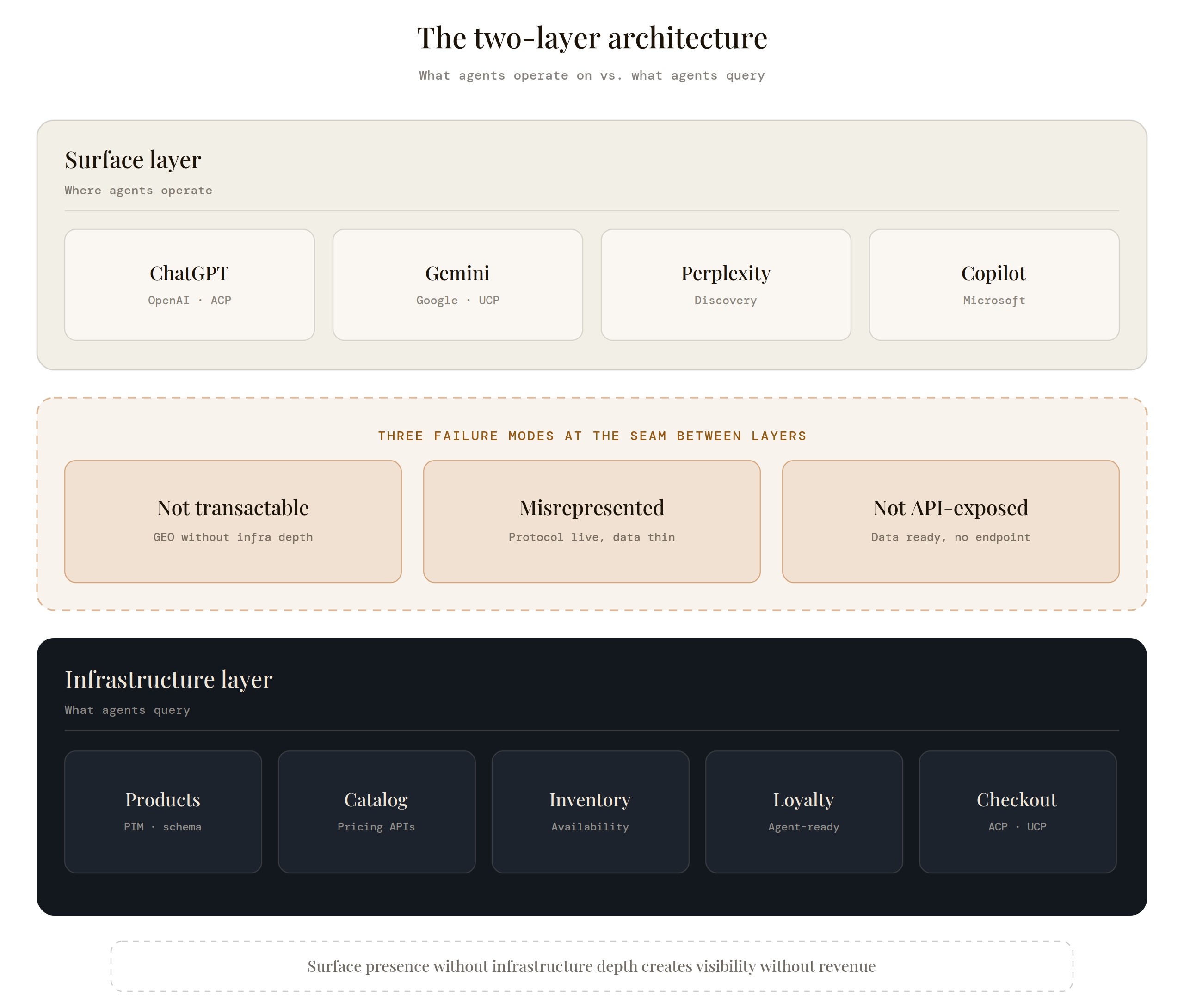
An agent does not crawl. It queries structured, pre-provided data. The brand that has done the work to supply that data clean, complete, machine-readable, directly integrated with the platform controls the recommendation, the comparison, and the conversion. The brand that has not done that work is not invisible because agents dislike them. They are invisible because there is nothing for the agent to query.
Gap's CTO Sven Gerjets said it directly: "It's not just keyword search anymore. It's conversations, and we need to be relevant to that." The relevance is not a content strategy. It is a data architecture.
Two additional details from the Gap announcement worth noting:
First, Gap's loyalty accounts are not yet connected to the Gemini checkout flow. That is the next infrastructure gap and a meaningful one. Discovery infrastructure and transaction infrastructure are not the same build. A brand that has done the data work to be findable inside Gemini has not automatically done the integration work to make loyalty redemption, personalized pricing, or account-level preferences accessible to the agent at checkout. Those are separate layers with separate requirements.
Second, UCP now supports loyalty integration, multi-item carts, and real-time catalog updates. Those are exactly the capability gaps that broke OpenAI's Instant Checkout in 2025. The infrastructure matured. The brand readiness question did not change; it became more specific.
Shopify made the same argument from the platform side
The same week as ShopTalk, Shopify rolled out Agentic Storefronts to all merchants by default. The talk on the floor got specific in ways that previous Shopify AI announcements have not.
Agents parse metafields, not HTML descriptions. If your product specifications, materials, dimensions, or compatibility data live only inside a description field written for human readers, an agent cannot extract structured information from it. The data needs to be in metafields, tagged with standard namespaces, and structured for machine parsing.
Agents rely on schema markup to understand your catalog. Schema.org Product, Offer, and Organization markup is no longer just a search ranking input. It is the machine-readable layer that allows an agent to correctly evaluate and compare your products against alternatives at query speed.
Agents require API-accessible checkout. A checkout flow that requires browser navigation, clicking through a cart, filling a form, and completing a payment page cannot be executed by an agent. Headless architecture and API-first checkout are no longer just technical modernization projects. They are the infrastructure that makes your products transactable by agents operating on behalf of consumers.
The framing Shopify is now pushing to merchants: you are building for two audiences simultaneously. The human buyer and the agent querying on their behalf have different infrastructure requirements, and most storefronts are currently built for only one of them.
That is the split experience. And it is not a future optimization task. It is a current visibility problem for any merchant whose product data is not structured for agent retrieval.
The protocol divergence is worth tracking
Sephora unveiled an AI-powered shopping experience inside ChatGPT at ShopTalk. The timing creates an interesting contrast.
OpenAI pulled back from checkout intermediation and pivoted to being a discovery and referral layer. Merchants receive high-intent traffic; transactions close on the brand's own storefront. The agent qualifies the buyer and hands them off.
Google is moving in the opposite direction with UCP toward in-platform checkout, loyalty integration, and real-time catalog access. The agent qualifies and closes.
Two different protocol bets, playing out simultaneously. Both require structured product data, API integration, and machine-readable catalog architecture. The infrastructure requirement is identical. What differs is where the transaction completes and who controls the checkout surface.
For brands, the practical implication is that building agent-readable infrastructure is not a bet on one protocol winning. It is the prerequisite for participating in either model. The brands sitting out the infrastructure build are not neutral on the protocol question. They are excluded from both.
The Coresight Day 1 summary named the gap precisely
Coresight Research, covering ShopTalk's Day 1 sessions, put it plainly: agentic commerce "remains in early stages, limited by gaps in infrastructure such as universal carts, APIs and standardized product data."
That sentence is an accurate description of where most brands are, not where the technology is. The technology has moved. UCP is live. Shopify's Agentic Storefronts are live. Gap is transacting inside Gemini today. The gap is not the platform. The gap is the brand infrastructure that has not been built to connect with it.
The conference theme was "Retail in the Age of AI." The subtext of every major announcement was that the age of AI is already here for the brands that built the infrastructure, and still theoretical for the brands that didn't.
What ShopTalk 2026 actually signals for brands
ShopTalk is where platforms announce to decision-makers with active technology budgets. The announcements this year were not previews. Gap's Gemini integration is live. Shopify's Agentic Storefronts are live. UCP is in production with Gap and rolling out to additional retailers.
The window between announcement and execution is where the readiness work happens. The brands at ShopTalk talking about agentic commerce in 2026 are the same brands that will be measured against it in 2027. The ones that leave ShopTalk with a clearer picture of the infrastructure requirements and move on them are positioned to be the Gap in that story. The ones that file it under "interesting developments to watch" are positioned to be the unnamed competitors Gerjets was gesturing at when he noted that no other major apparel brand had announced a similar Gemini partnership.
The readiness question is not whether agents will mediate commerce. That question was answered at ShopTalk this week. The readiness question is whether your product data, your catalog architecture, your checkout infrastructure, and your loyalty data are accessible to agents operating on your customers' behalf.
If you do not know the answer to that question, the answer is probably no, and the cost of that answer is accumulating now.
Correction, September 27, 2026. In the list of what Shopify's Agentic Storefronts require, this post said agents rely on schema markup to understand your catalog. Shopify's documentation does not say that. Agentic Storefronts give agents product data through the Shopify Catalog, where metafields, metaobjects and tag prefixes are mapped with Catalog Mapping, and checkout runs through Shopify checkout. Schema.org markup still matters to crawlers and answer engines that read your pages; it is not how Agentic Storefronts expose your catalog.