For thirty years, UX research assumed one audience. The agent era requires designing for two simultaneously, and the harder problem is the one nobody is writing patterns for yet.
The field has a name for it now.
Fuselab Creative calls it Agent UX. Peterson Technology Partners calls it AX Agentic Experience Design. A paper presented at CHI 2026 in Barcelona formalized it as the "dual-audience interface" problem: the Human-Agent-UI triangle, in which every interface must simultaneously serve the human who sets intent and the agent that executes it.
The framing is correct. The coverage is incomplete.
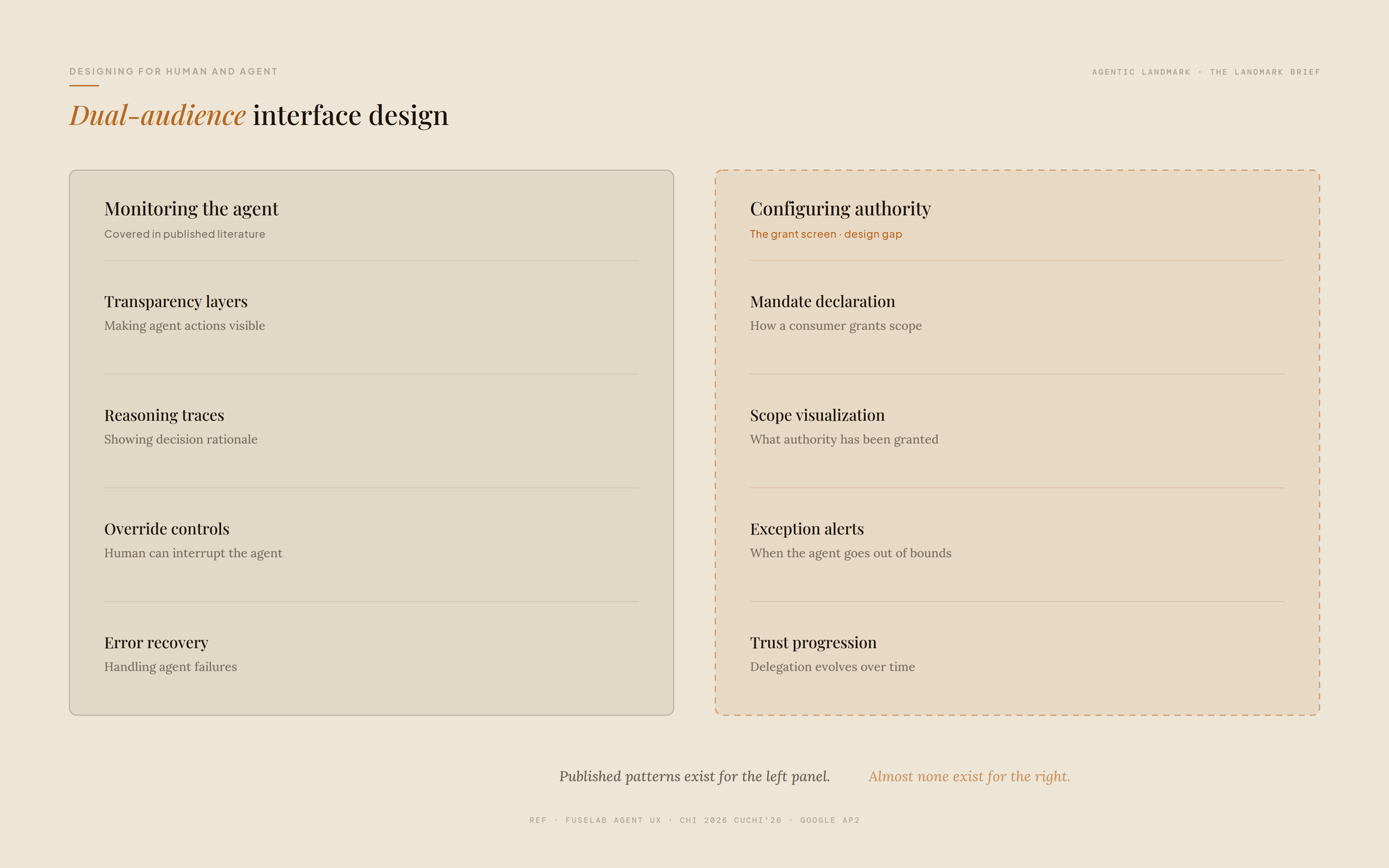
Most of the emerging literature on designing for human and agent audiences focuses on the same half of the problem: how to make the agent's actions visible and interpretable to the human watching it work. Transparency layers. Reasoning traces. Override controls. Confidence indicators. Error recovery patterns. This is valuable design work, and it is urgently needed.
But there is a second design problem that precedes all of it, and almost no one is writing patterns for it yet.
The producer-side problem vs. the consumer-side problem
The dual-audience interface literature is almost entirely focused on what you might call the producer side: organizations deploying AI agents inside their own products to help users accomplish tasks. The Fuselab piece describes a clinical AI interface where clinicians refused to use a recommendation system that surfaced suggestions without explaining its reasoning. NNGroup's State of UX 2026 identifies trust as the defining design challenge. The CHI 2026 paper proposes representational compatibility, transparency, and low barriers as the three design properties that matter most.
All of this is describing the same moment: a human is watching an agent do something on their behalf, and the interface must make that action legible, controllable, and trustworthy.
That is not the hardest design problem in the agent era. The hardest design problem comes before the agent does anything at all.
The grant screen: the most consequential undesigned surface
When a consumer configures an AI shopping agent setting a price ceiling, selecting preferred brands, defining substitution rules, and establishing exception conditions, they are creating something that has no real UX precedent: a purchase mandate. A structured, machine-executable declaration of intent that will govern the agent's behavior across every transaction within its scope, potentially for months.
Google's Agent Payments Protocol shipped this summer. AP2 lets a consumer delegate purchases inside bounded conditions, "buy these Nike Pegasus 41s in size 10 if they hit $90," using cryptographically signed digital mandates with a verifiable audit trail. The protocol infrastructure exists. The UX that makes this delegation legible, configurable, and trustworthy for mainstream consumers has barely been designed.
This is the grant screen problem. And it is structurally different from the dual-audience interface problem most designers are currently working on.
The transparency layer and override controls that Fuselab and others are designing help a human understand and correct what an agent is doing. The grant screen determines what the agent is allowed to do in the first place. One is about monitoring execution. The other is about configuring authority. These are different design problems with different success criteria, different failure modes, and different consequences when they go wrong.
Why the grant screen is harder than it looks
Traditional UX research has a well-developed vocabulary for preference declaration. Settings screens. Preference panels. Onboarding flows. These are established patterns for collecting user input that shapes system behavior.
The grant screen is not a settings screen. It is an authorization instrument. The user is not setting preferences that the system will try to honor. They are granting authority that an autonomous agent will act on, potentially executing transactions, committing funds, and making decisions in the user's name without per-transaction confirmation.
The design implications are specific:
Scope legibility. The user must understand what they are granting authority over. Not in legal terms, in experiential terms. "Price ceiling: $150" is clear. "Substitution rules: allow equivalent items from approved brands" is not clear to most consumers. The gap between what the user believes they authorized and what the agent believes it is authorized to do is the primary source of trust failures in agent-mediated commerce. Closing that gap is a language design problem, an interaction design problem, and a mental model problem simultaneously.
Reversibility and editability. Mandates must feel provisional, not permanent. A consumer who believes their agent authority is difficult to revoke will either not grant it at all or grant it without reading what they are agreeing to. Neither outcome serves them. The grant screen must make the mandate feel like a standing instruction they are in control of, not a contract they are signing.
Exception design. The most consequential design decision in the grant screen is not what the agent is allowed to do. It is what happens at the edges of that authority. When the agent encounters a situation outside its declared parameters, the preferred brand is out of stock, the price dropped below the floor, the specifications changed, what does it surface, and how? Exception handling design determines whether agent delegation feels trustworthy or unpredictable.
Trust calibration over time. The consumer who delegates for the first time should have a different experience from the consumer who has delegated successfully for six months. First-delegation flows need more friction, more explicitness, more confirmation. Established-delegation flows should reduce that friction deliberately. Most grant screen design treats all consumers as first-time delegators, which is the right default and the wrong long-term model.
What the field needs
The producer-side dual-audience interface problem is getting serious design attention. The consumer-side authorization design problem is not, and the infrastructure that requires it is already in production.
The patterns that need to be developed:
The mandate declaration interface how a consumer expresses bounded authority in language and interaction models that are both machine-parseable and humanly understandable.
The scope visualizes how a user sees what they have authorized across multiple active mandates, across multiple categories, across multiple agents operating on their behalf.
The exception alert design how an agent surfaces out-of-bounds situations in a way that gets timely human review without creating alert fatigue.
The trust progression model how delegation experiences should evolve as the consumer builds a track record with a specific agent or brand.
These patterns do not yet exist at the level of specificity that interaction design requires. The CHI 2026 paper on dual-audience interfaces is an academic starting point. The Fuselab and Peterson Technology work addresses the monitoring side. The authorization side is the gap.
For UX researchers and interaction designers: the grant screen is the most important new design surface in commerce, and the one with the least published guidance. The work that needs to happen here is foundational, defining the vocabulary, the patterns, and the failure modes of consumer-facing delegation interfaces before the infrastructure scales past the point where the design can catch up.
The transparency layer problem has designers working on it. The authorization design problem is still waiting for them.
Correction, September 27, 2026. This post said AP2 shipped that infrastructure. The AP2 protocol specification was published in September 2025, defining cryptographically signed mandates, but no product had shipped. Google has announced AP2 for its own products, starting with Gemini Spark, and as of this note no Google source confirms it has shipped there.