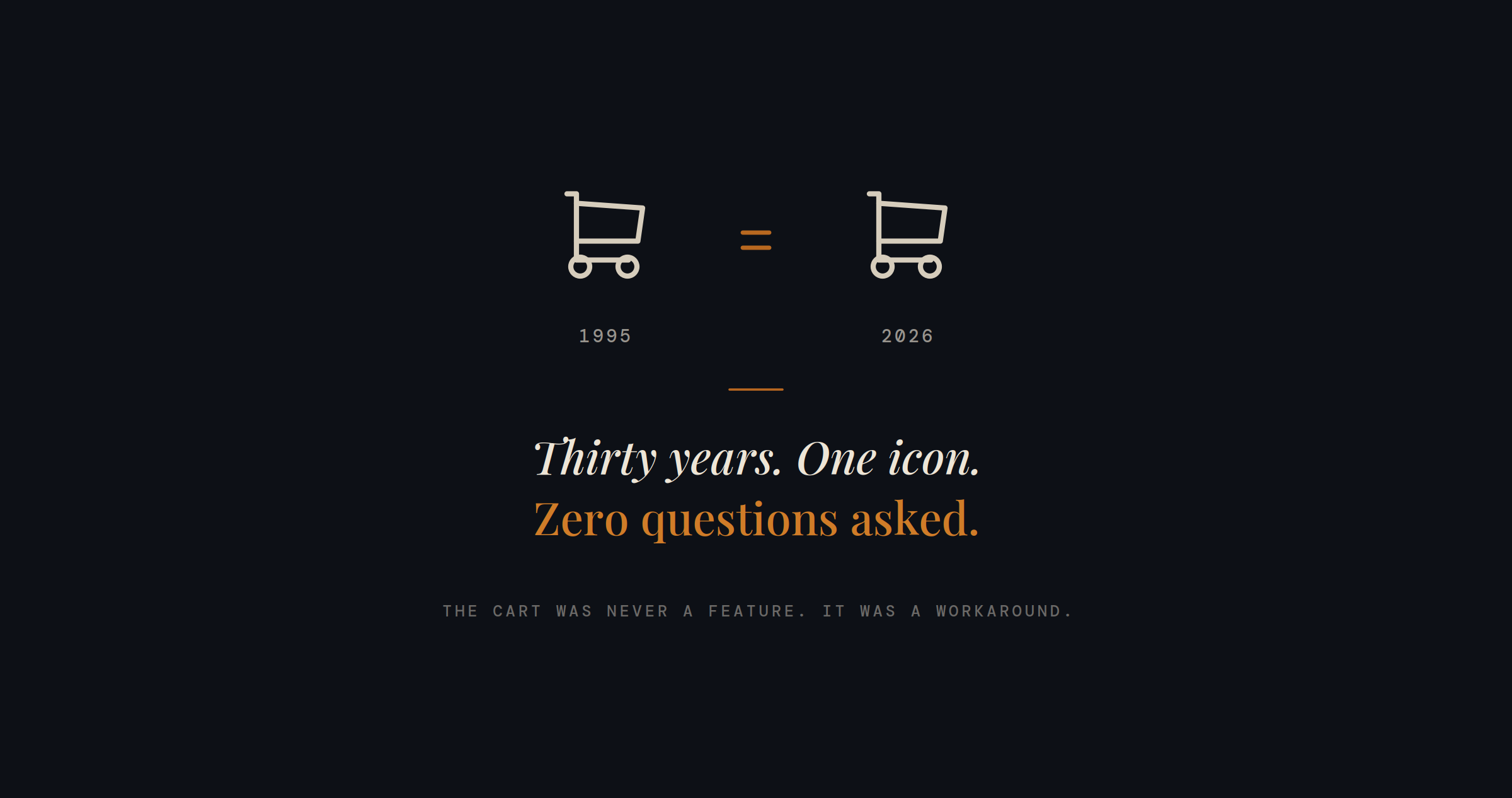
Look at the top-right corner of almost any e-commerce site.
There it is. A little shopping cart icon. Same as it was in 1995.
We've redesigned everything about online shopping in thirty years: search, recommendations, payments, delivery, and mobile. But the cart remained. We never questioned it.
We should have.
The shopping cart is a skeuomorph. A digital artifact that mimics physical behavior for no reason other than familiarity. It made sense when the internet was new, and users needed recognizable metaphors. You push a cart through a store. You add things to it. You wheel it to the register.
But we're not in 1995. And increasingly, we're not shopping that way either.
When an AI agent handles a purchase, there is no cart. There's no gathering phase. No browsing, no comparing, no adding, no abandoning. The agent already knows what's available, has already evaluated the options, and executes when appropriate.
Seventy percent of online shopping carts are abandoned before purchase. Seven in ten. We've accepted that number as normal for so long that most brands have entire CRO programs dedicated to recovering them.
But the cart abandonment problem doesn't get solved in an agent world. It disappears. Because the cart disappears.
The cart was never a feature. It was a workaround, a bridge between physical retail and something we hadn't yet invented.
That something is here.
Brands still optimizing cart completion rates are optimizing the last step of a process that is being bypassed at the first step.
The question isn't how to reduce abandonment. It's whether your infrastructure is visible, evaluable, and transactable before a consumer ever decides to gather anything.